Money is not the bottleneck: what the 2027 defence budget reveals about the Bundeswehr
Translated from the German original on 19 November 2026.
Key points
- Since the 2025 amendment to the Basic Law, money is currently not the scarcest resource for the Bundeswehr: for 2027, the defence budget and the special fund together provide around €140 billion, just over 60 per cent more than in 2025.
- The bottleneck lies on the way from budget line to military capability: in 2025, almost a fifth of the planned funds in the special fund were not spent, and planning assumes billions will again go unspent in 2026 and 2027.
- Contracts signed today determine spending in later years: the 2026 and 2027 budgets allow commitments totalling more than €640 billion; according to the Federal Court of Auditors, this would severely limit room for manoeuvre from 2028.
- The three laws on procurement, construction and the reserve – one in force, two still in the legislative process – address the right problems and place a comparatively small burden on the budget. However, their effect is only partly subject to binding review.
- Instead of new record sums, policymakers should focus on transparency about spending, delivery dates and prices, and make competition an objective of procurement.
On 8 October, the Bundestag’s Budget Committee will debate the defence budget for 2027 (German Bundestag, 2026 (öffnet in neuem Tab)). The sums involved are higher than ever. This analysis shows that money is currently not the scarcest resource for the Bundeswehr. The bottleneck lies on the way from approved funds to actual capability: from budget line to contract, from contract to equipment, ammunition and barracks that are available in time, and to personnel who can use them. Three laws tracked by the edznotes legislation monitor (in German) address exactly these points. They target the right problems, but their effect is only partly subject to binding review. What should follow is therefore less a question of additional billions than one of transparency and competition.
A budget without a fixed ceiling
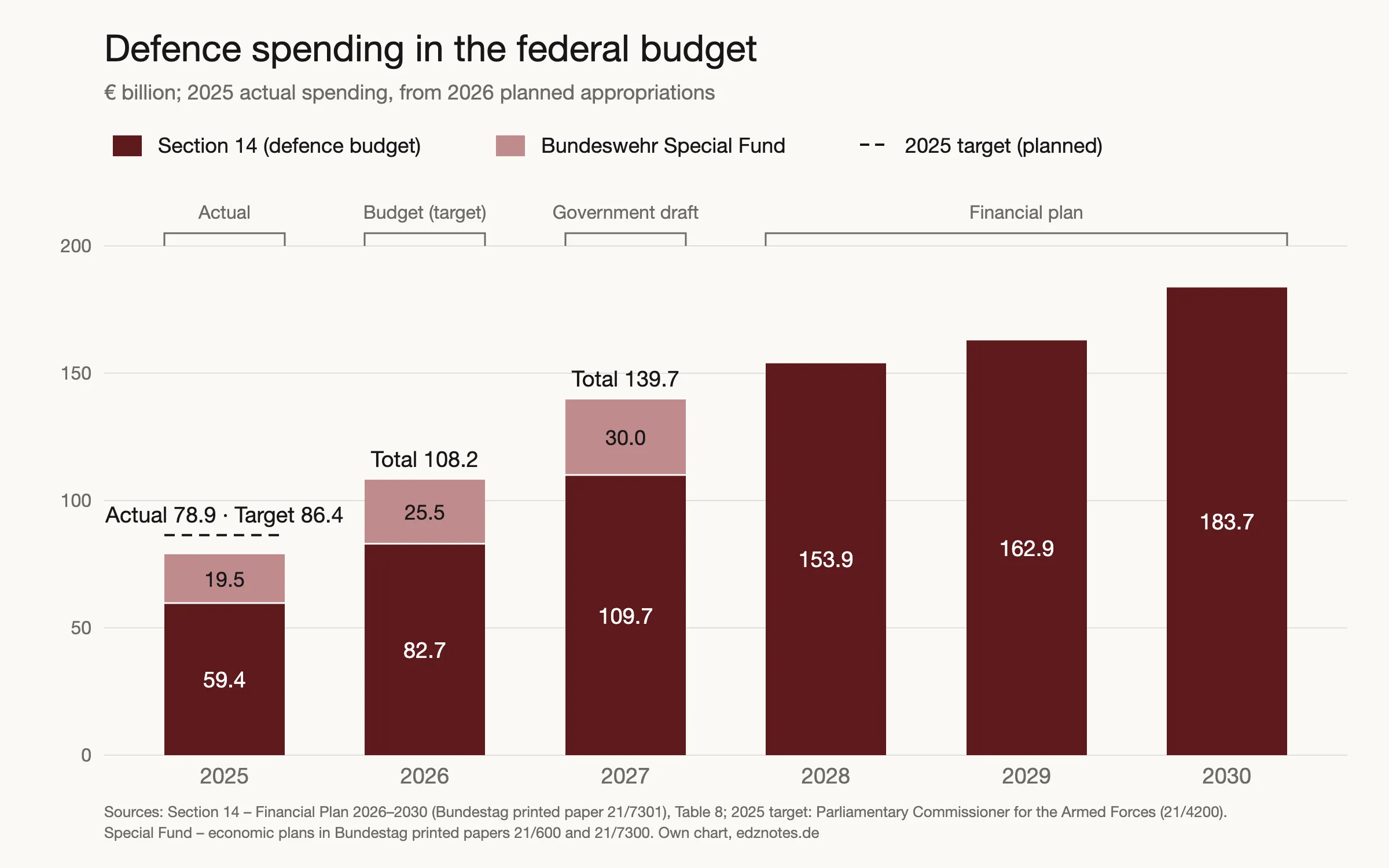
For 2027, the government draft provides around €109.7 billion in Section 14, the defence budget within the core federal budget – some €27 billion more than in 2026. On top of this come almost €30 billion from the Bundeswehr Special Fund (Federal Government, 2026a (öffnet in neuem Tab)). Together, this amounts to around €140 billion; in 2025, the target was around €86 billion (Parliamentary Commissioner for the Armed Forces, 2026 (öffnet in neuem Tab); Federal Government, 2025a (öffnet in neuem Tab)). The financial plan foresees an increase in Section 14 to €183.7 billion by 2030. According to the plan, the special fund will be used up by the end of 2027; after that, the core budget will bear the costs alone (Federal Government, 2026b (öffnet in neuem Tab)).
This is made possible by the amendment to the Basic Law of March 2025. Since then, spending on defence, civil protection, the intelligence services, IT security and aid to states under attack such as Ukraine no longer counts towards the debt brake, insofar as it exceeds one per cent of gross domestic product in total (Federal Law Gazette, 2025 (öffnet in neuem Tab)). The Basic Law sets neither a ceiling nor a time limit for this exemption. In 2027 alone, it allows additional borrowing of €85.4 billion, and around €495 billion in total from 2027 to 2030; by far the largest share goes to the defence budget (Federal Government, 2026b (öffnet in neuem Tab)). How much money the Bundeswehr actually receives, however, is still decided by the Bundestag each year in the Budget Act.
The composition is also shifting. The item for military procurement, maintenance of materiel, construction and research accounted for around a third of actual spending in Section 14 in 2025; in the draft for 2027, it is around half (Federal Government, 2026a (öffnet in neuem Tab)). According to NATO criteria, which are defined differently from the federal budget, Germany is expected to spend 2.69 per cent of its economic output on defence in 2026 (NATO, 2026 (öffnet in neuem Tab)). The Federal Government aims to reach 3.5 per cent as early as 2029 (Federal Government, 2026b (öffnet in neuem Tab)).
Where the money gets stuck
Whether money turns into defence capability is shown not by the target but by actual spending, i.e. what is really spent. In Section 14, around 95 per cent of the planned funds were spent in 2025, €59.4 billion out of €62.3 billion (Parliamentary Commissioner for the Armed Forces, 2026 (öffnet in neuem Tab)). In the special fund, it was only around 81 per cent: of €24.1 billion, €19.5 billion was spent (Federal Government, 2025a (öffnet in neuem Tab); Federal Government, 2026a (öffnet in neuem Tab)). Among the reasons for underspending, which already occurred in 2024, the Parliamentary Commissioner for the Armed Forces cites delays on the part of industry and disruptions in project workflows (Parliamentary Commissioner for the Armed Forces, 2026 (öffnet in neuem Tab)). Planning already factors in the shortfall: the economic plan of the special fund includes global spending reductions of €8.7 billion for 2026 and €5.0 billion for 2027 (Federal Government, 2026a (öffnet in neuem Tab)).
It could be argued that money not spent is often simply spent later. In fact, in 2025 the Budget Committee approved 103 proposals of more than €25 million each, with a total volume of around €83.8 billion (Parliamentary Commissioner for the Armed Forces, 2026 (öffnet in neuem Tab)). But this only shifts the bottleneck, from contract to delivery. According to an analysis by the Kiel Institute, no date for complete delivery is publicly given for a growing share of German orders, most recently for around 70 per cent; where a date is given, delivery is planned on average only after four to five years (Kiel Institute, 2026 (öffnet in neuem Tab)).
Today’s contracts, tomorrow’s room for manoeuvre
A second finding gets less attention in the debate. With commitment appropriations, the Bundestag allows contracts to be concluded that will only be paid for in later years. The 2026 budget contains such appropriations of €349.5 billion in Section 14, and the draft for 2027 a further €291.9 billion (Federal Government, 2025a (öffnet in neuem Tab); Federal Government, 2026a (öffnet in neuem Tab)). What this means for the following years was calculated by the Federal Court of Auditors in a report to the Budget Committee dated 7 September. The report has not yet been officially published – the Court of Auditors only releases it once the deliberations are complete – but it is publicly available via Table.Media (Federal Court of Auditors, 2026 (öffnet in neuem Tab)). If the appropriations were used in full, 68 per cent of the amounts foreseen in the financial plan for 2028 and for 2029 would already be contractually committed; together with the largely fixed costs of operations and pensions, the funds in those years would not be sufficient. It is more realistic that only part of the appropriations will be used. But even at two thirds, around 85 per cent of the 2029 allocation would, by the Court of Auditors’ calculation, be practically fixed.
Long-term contracts make sense: they give manufacturers the planning certainty they need to expand their capacities. But they also come at a price when demand grows faster than supply. In its report, the Federal Court of Auditors observes a “tendency” for additional borrowing options, increased demand and limited competition to drive up prices, and speaks of “armaments inflation” (Federal Court of Auditors, 2026 (öffnet in neuem Tab)). In its opinion on the budget, the Bundesrat therefore calls for a “more targeted procurement strategy in order to avoid procurement costs for military equipment that are not in line with the market” (Bundesrat, 2026 (öffnet in neuem Tab)). The Kiel Institute also observes that the share of purely German suppliers in orders rose from a third in 2020 to two thirds in 2025 (Kiel Institute, 2026 (öffnet in neuem Tab)). Where few suppliers face rapidly growing demand, more money strengthens their negotiating position, not automatically that of the Bundeswehr.
Three laws for three bottlenecks
Three laws whose progress is tracked by the legislation monitor (in German) address these bottlenecks: one is in force, two are government bills. None of them is a spending law.
The Bundeswehr Procurement Acceleration Act (BwBBG) is part of the Planning and Procurement Acceleration Act. The BwBBG has been in force since February 2026 and expires at the end of 2035. It makes exemptions from public procurement law easier, permits advance payments and suspends the principle of dividing contracts into smaller lots (Federal Law Gazette, 2026 (öffnet in neuem Tab)). According to the Federal Government’s cost estimate, it does not cause any new expenditure (Federal Government, 2025b (öffnet in neuem Tab)). It speeds up procedures but does not answer the question of delivery capacity and prices. Suspending the principle of dividing contracts into lots may even increase dependence on individual suppliers.
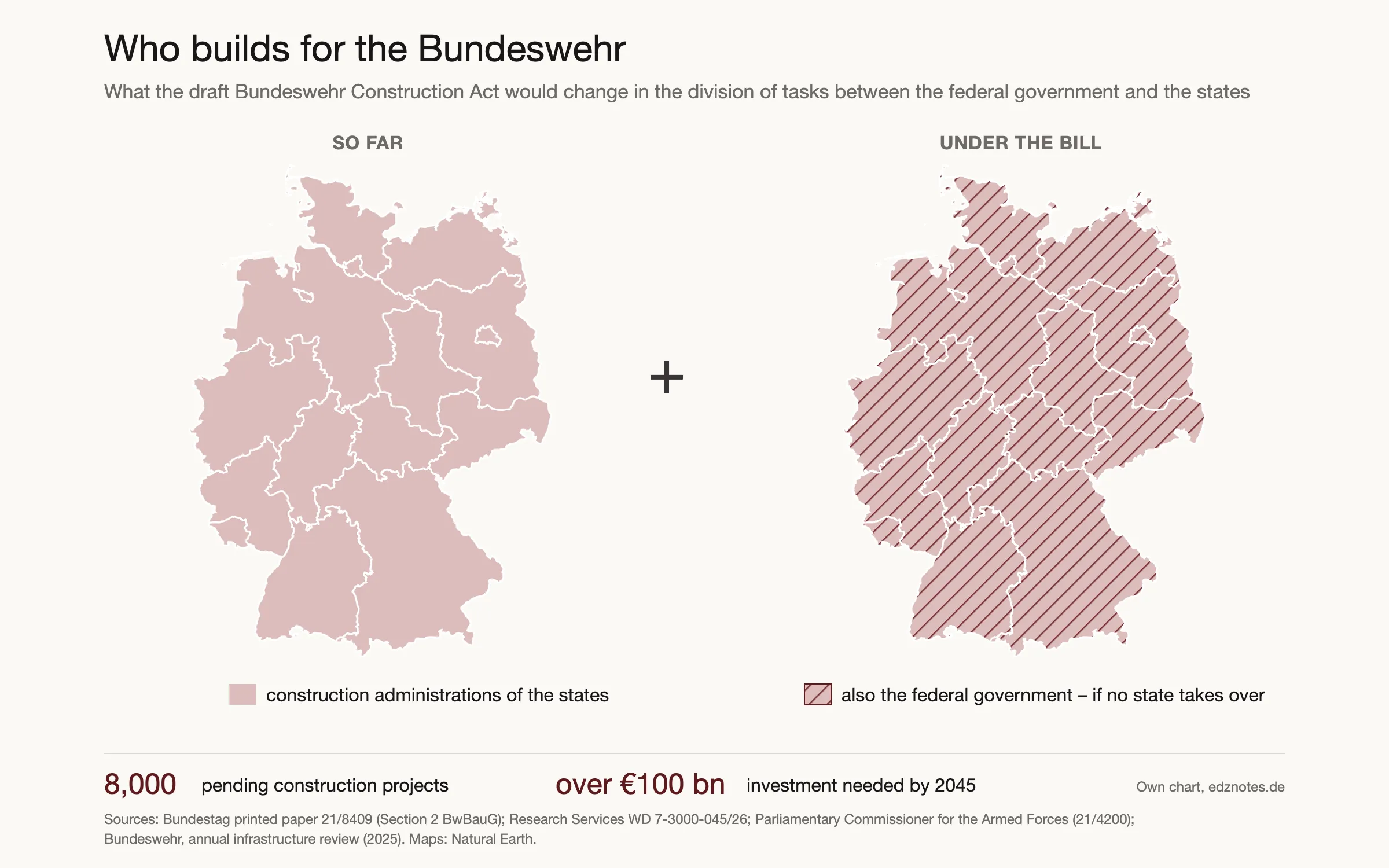
The Bundeswehr Infrastructure Acceleration Act targets construction. According to the Defence Ministry’s infrastructure report, the investment needed for military infrastructure amounts to more than €67 billion into the 2040s, with around 8,000 construction projects pending (Parliamentary Commissioner for the Armed Forces, 2026 (öffnet in neuem Tab)). Until now, the construction administrations of the federal states have built for the Bundeswehr. The bill considers it possible that they will not be able to meet demand in time “even with a maximum increase in construction turnover”, and therefore allows the Bundeswehr itself or specially established companies to build (Federal Government, 2026c (öffnet in neuem Tab)). The bill assumes cost neutrality, because reimbursements to the federal states will no longer apply; it does not quantify the personnel required to build up the Bundeswehr’s own construction capacity. As additional costs, it mainly cites up to around €210 million over five years for shared accommodation. And it states: “No evaluation is planned.”
The Reserve Strengthening Act targets personnel. In 2025, 60,192 reservists were assigned to a post; from 2033, at least 200,000 are to be available (Parliamentary Commissioner for the Armed Forces, 2026 (öffnet in neuem Tab)). From 2027, the bill expects costs of around €43 million a year, mainly for uniform items, payments under the Unterhaltssicherungsgesetz, which compensates reservists for loss of earnings, and pension contributions (Federal Government, 2026d (öffnet in neuem Tab)). Equipment, training and accommodation for a significantly larger reserve are not included. The financial plan for 2027 still provides for 7,500 reservists in service (Federal Government, 2026b (öffnet in neuem Tab)).
What all three laws have in common is that they address procedures rather than the budget. That is right, because that is where the bottlenecks lie. Impact assessment, by contrast, is inconsistent. The BwBBG is time-limited and requires a report on further exemptions; the coalition parliamentary groups promised an external evaluation and annual reports from the end of 2027 in the committee report, but these are not in the text of the law (Committee on Economic Affairs and Energy, 2026 (öffnet in neuem Tab)). The draft Reserve Strengthening Act announces an evaluation after two years in its explanatory memorandum. The infrastructure act contains none at all.
What should follow
First, the Bundestag should measure what arrives, not just what is approved. A regular report to the Budget and Defence Committees should show target and actual spending and the commitment appropriations used for each chapter, together with deviations in delivery dates and prices for major projects; where security interests are affected, as a classified document. The annual reports promised for the procurement act would be an obvious starting point.
Second, the acceleration laws should be given a binding impact assessment. For the infrastructure act, measurable targets would be an obvious choice, such as the annual construction volume, the time from requirement to use and the share of projects carried out by the federal government itself. For the procurement act, the promised evaluation should be written into the text of the law.
Third, competition should become an objective of procurement, not its casualty. Binding delivery dates and penalty clauses should be standard in large contracts; for ammunition and air defence, second sources of supply and joint European orders would make sense. If the principle of dividing contracts into lots is suspended, this should be justified.
Conclusion
The Bundeswehr has more money at its disposal than ever, and the Basic Law allows it to be financed through borrowing without a fixed ceiling. The real problem lies in implementation: funds are spent more slowly than planned, many deliveries have no public date, construction projects are waiting for capacity, and contracts concluded today determine spending in the coming years. The three laws on procurement, construction and the reserve address these points. But whether they deliver on their promises will only be known if it is measured. What should be measured in future is therefore less how much is approved than how much of it arrives as capability.