The Luftwaffe after FCAS
How Germany is deciding on a new European fighter, loyal wingmen and more F-35s after the collapse of the joint FCAS fighter
Key points- Key point 1 of 6
In 1971, the Federal Government decided to procure 175 US F-4F Phantoms because the European Tornado would not be available before 1977/78. The Phantom was meant to fill a gap and remained in service until 2013.
- Key point 2 of 6
In 2022, the pattern repeated itself: for nuclear sharing, the Federal Government opted for the US F-35. In the long run, it was to be replaced by FCAS, the joint European project.
- Key point 3 of 6
In June 2026, Germany and France declared the joint FCAS fighter a failure. France is continuing alone, which for now leaves Germany without a European successor to the Eurofighter and the F-35.
- Key point 4 of 6
According to Handelsblatt, Chancellor Merz favours GCAP as the successor, while Defence Minister Pistorius leans towards a German-led route with Sweden; the Luftwaffe leadership is considering more F-35s. A decision on the direction is due in the first quarter of 2027.
- Key point 5 of 6
Loyal wingmen have not got off to a quick start either: the Defence Ministry has halted the direct purchase of the Australian MQ-28 “Ghost Bat”. Several systems will be compared from 2027, with the first aircraft now expected in the early 2030s.
- Key point 6 of 6
In edznotes' assessment, Germany should now develop loyal wingmen – and the software that runs them – under its own control and, for the fighter, choose the route that secures it a major role.
Translated from the German original on 19 November 2026.
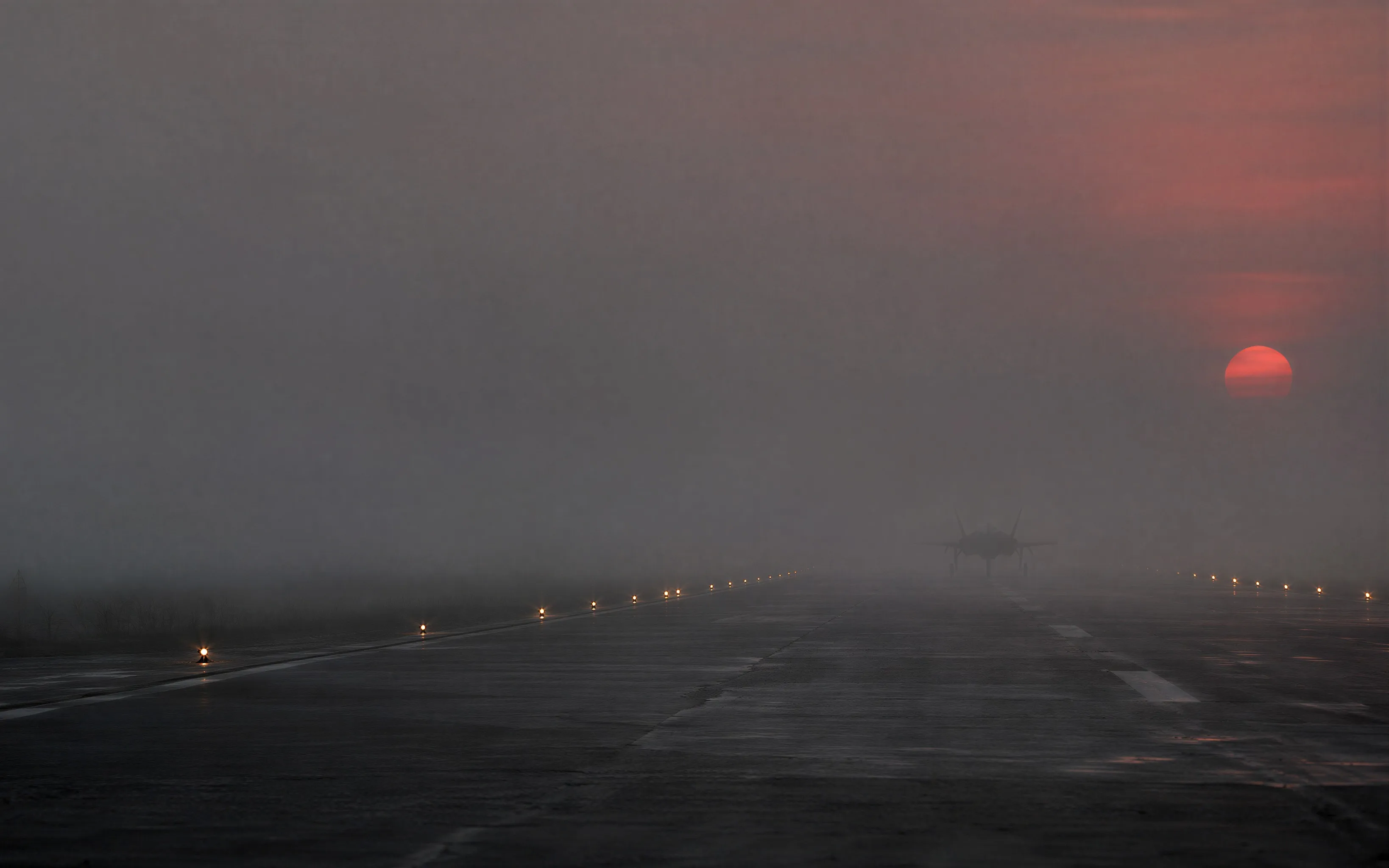
Symbolic image: combat aircraft on a runway in the morning mist.AI-generated with Envato
→ Go straight to the recommendations
In June 2026, Germany and France declared the joint fighter in the FCAS project a failure (Federal Government, 2026a (öffnet in neuem Tab)). In September, Defence Minister Boris Pistorius took delivery of the first German F-35 in Texas (Federal Ministry of Defence, 2026a (öffnet in neuem Tab)). In mid-October, Boeing confirmed that the Defence Ministry had informed the company that it would not procure the MQ-28 “Ghost Bat” uncrewed aircraft directly (Breaking Defense, 2026a (öffnet in neuem Tab)).
All three developments come down to the same question: will Germany build its future air force with European partners or buy American? In 2027, that question will be settled on three fronts at once: in the comparison of loyal wingmen, in the choice of direction for the next fighter and in whether to buy more F-35s. For the loyal wingmen, the issue is less which country the aircraft comes from than how much of it is produced in Germany and who controls the software. This analysis shows how the three projects are connected, who in the Federal Government, the Bundestag, the Bundeswehr and industry favours which option, and which solution appears realistic.
Key recommendationThe analysis recommends developing loyal wingmen, including their software, under German control now and, for the fighter, choosing the route that secures Germany a major role: as things stand, a programme with Sweden and Spain, or GCAP if it offers genuine full membership. Until the new fighter arrives, the existing Eurofighters and those already on order should bridge the gap, supplemented by more F-35s where the Luftwaffe needs stealth capability. This only works if Germany commits to one programme and sees it through; otherwise the bridge risks becoming a permanent fixture once again.
The question of whether to go with European partners or with the USA is not new. The Luftwaffe has had to answer it several times over the past seventy years, and twice a US fighter ended up filling the gap.
Seventy years between Washington and Europe
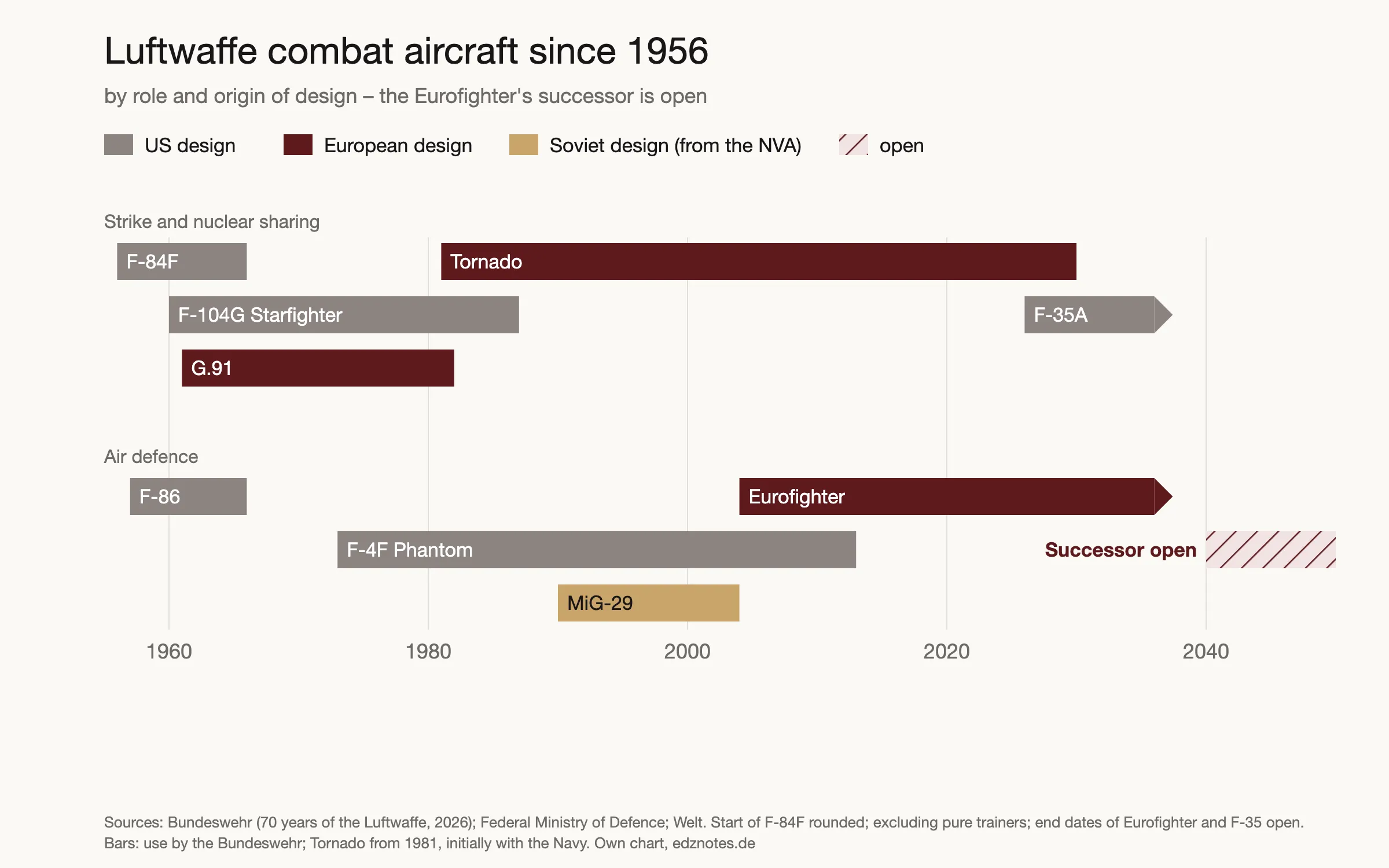
Figure 1: Between Washington and Europe. The colours show the origin of the design, not who controls the aircraft. The bars show use by the Bundeswehr, not development. Own chart.
A brief look back: The Luftwaffe started out in 1956 with US fighters, instructors and manuals. Even its first fighter-bombers were equipped to deliver US nuclear weapons as part of nuclear sharing. From the 1960s onwards, the Federal Republic increasingly relied on European programmes: first the Tornado, then the Eurofighter. Twice, however, a European programme came too late or turned out smaller than planned, and both times a US type filled the gap. In 1971, it was the Phantom, because the Tornado would not be available before 1977/78; it was mainly meant to win air superiority and remained in service alongside the Tornado until 2013. In 2022, it was the F-35, because FCAS would have come too late to replace the Tornado. Whether it remains a bridge or also becomes a permanent fixture is the question at the heart of this analysis.
Read the full story: from 1956 to the Eurofighter about 5 minutes' reading time
Which fighters the Luftwaffe flies has never been just a question of technology. Every decision reflects the Federal Republic’s situation at the time: what it could build itself, whom it relied on and what it was prepared to pay for. This analysis looks at two roles of its combat aircraft: strikes on targets on the ground, which under NATO nuclear sharing also include the delivery of US nuclear weapons, and the defence of airspace (Figure 1).
1956: A fresh start with US help
When the Luftwaffe was set up in 1956, it lacked, by its own account, “almost everything: jets, structures, experience” (Bundeswehr, 2026a (öffnet in neuem Tab)). It had no aircraft of its own. The Federal Republic had joined NATO a year earlier, and the alliance demanded rapid operational readiness in the face of the Warsaw Pact. The young Luftwaffe thus took on a distinctly American character. Its first pilots learned to fly in Texas, Arizona and Georgia in 1955 and 1956, and with the aircraft came manuals, checklists and English as the working language (Bundeswehr, 2026a (öffnet in neuem Tab)). For the strike role, it received around 450 F-84F fighter-bombers from the USA (ZMSBw, 2026 (öffnet in neuem Tab)); for air defence, 225 Canadian-built Sabre Mk 6 fighters, which flew until 1966 (Deutsches Museum, n.d. a (öffnet in neuem Tab)). The F-84F was “reliable, easy to maintain and available”, the Bundeswehr writes today – exactly what a fledgling air force needed (Bundeswehr, 2026b (öffnet in neuem Tab)).
The F-84 also marked the beginning of the Luftwaffe’s nuclear role. The Federal Republic was not to have nuclear weapons of its own, but it was brought into NATO nuclear sharing. The F-84 fighter-bombers were equipped to deliver tactical US nuclear weapons; from the outset, decisions on their use rested with the USA (Federal Archives, n.d. (öffnet in neuem Tab)).
1958: The Starfighter is supposed to do it all
Just two years later, a successor was needed – and the choice became a matter of principle. The new fighter was to attack targets on the ground, conduct reconnaissance, defend airspace and also take on the nuclear role. After comparative flights, including with the French Mirage III, Germany chose the US F-104G Starfighter at the end of October 1958; in November, the Defence Committee took up the matter, as Franz Josef Strauß later recounted in the Bundestag (Plenary record 4/156, 1965 (öffnet in neuem Tab), pp. 7703 f.).
For German industry, this was a new beginning. The Starfighter was also built under licence in Germany, by Messerschmitt, Dornier and Heinkel among others (Deutsches Museum, n.d. b (öffnet in neuem Tab)). It flew with the Luftwaffe until 1987 (Bundeswehr, 2026b (öffnet in neuem Tab)); the Bundeswehr fleet was retired in 1991 (Deutsches Museum, n.d. b (öffnet in neuem Tab)).
At the same time, the Federal Republic took a first step towards Europe. For light ground attack, it procured the Italian Fiat G.91, which entered Luftwaffe service from 1961 (Bundeswehr, 2019 (öffnet in neuem Tab)). It remained in service until 1982, “[l]onger than planned, because it simply worked” (Bundeswehr, 2026b (öffnet in neuem Tab)).
1969 to 1981: The Tornado goes European, the Phantom fills the gap
The successor was to be developed jointly. At the end of the 1960s, several NATO states wanted to replace their Starfighters; Germany, Britain and Italy decided to develop a multi-role combat aircraft together for this purpose, the MRCA, later the Tornado. In 1969, BAC, MBB, Fiat and the Dutch company Fokker founded the Panavia consortium (BAE Systems, n.d. (öffnet in neuem Tab)).
Initially, the MRCA was to take on almost everything. According to the 1970 White Paper, it was intended for ground attack “and for winning air superiority limited in space and time” and was to replace the Starfighter and the G.91. But costs forced cutbacks: instead of the 800 aircraft originally planned, the Bundeswehr wanted to procure “at most up to 420”, and because the MRCA “will not be available before 1977/78, a gap arises here that must be bridged” (Federal Government, 1970 (öffnet in neuem Tab), pp. 143 f.).
It was filled with a US type. According to the 1971/72 White Paper, the Federal Government decided in 1971 to procure 175 F-4F Phantom II fighters, a German version of the McDonnell Douglas type (Federal Government, 1971 (öffnet in neuem Tab), p. 20). The two governments signed the contract on 31 August 1971; this is recorded in the Documents on the Foreign Policy of the Federal Republic of Germany, published by the Institute for Contemporary History (AAPD, 1973 (öffnet in neuem Tab), vol. I, doc. 15, note 7, p. 60). The decision also kept German arms purchases in the USA at their previous level – purchases the Federal Republic used to offset the foreign-exchange costs of US troops stationed in Germany (Federal Government, 1971 (öffnet in neuem Tab), p. 20). The White Paper also reassigned the roles: the Phantom was to win air superiority, after conversion also defend airspace and support the army from the air, while the MRCA was to take on deep strike (Federal Government, 1971 (öffnet in neuem Tab), p. 144). From the outset, the Phantom was therefore more than a temporary stopgap. It arrived in 1973 and remained in service until 2013, for long stretches alongside the Tornado (Bundeswehr, 2026b (öffnet in neuem Tab)). A stopgap had become a permanent fixture – and it would not be the last.
From 1981, the Tornado entered Bundeswehr service, first with the Navy and then with the Luftwaffe (Bundeswehr, 2020a (öffnet in neuem Tab)). With it, the Luftwaffe’s nuclear role passed during the 1980s from the US Starfighter to a European aircraft. German industry played a major part in development and production.
1985 to 2004: The Eurofighter, a familiar dispute and reunification
For air defence, Europe also wanted to build its own fighter, and in the process a dispute emerged that would recur in similar form forty years later. France demanded a lighter aircraft that could also take off from aircraft carriers, a larger share of the work and the leadership (RAF Air Historical Branch, n.d. (öffnet in neuem Tab), pp. 9 f., 13, 21). On 1 August 1985, Britain, the Federal Republic and Italy reached agreement in Turin without France; Spain joined shortly afterwards (RAF Air Historical Branch, n.d. (öffnet in neuem Tab), p. 34). France developed the Rafale alone with Dassault, as Senator Olivier Cadic summarised in the French Senate’s defence committee in 2021 (Sénat, 2021 (öffnet in neuem Tab)). Leadership, work shares and a carrier-capable aircraft: similar questions arose with FCAS in 2026.
Germany, Britain, Italy and Spain carried on without France. While they were developing the fighter, reunification brought the Luftwaffe an unusual addition: MiG-29s of the National People’s Army. The 24 aircraft were adapted for NATO, stood on quick reaction alert to protect the airspace and were sought-after adversaries in NATO exercises (Bundeswehr, 2020b (öffnet in neuem Tab)). In 2003 and 2004, the Bundeswehr handed the 23 remaining aircraft over to Poland (Bundeswehr, 2020b (öffnet in neuem Tab)).
With the end of the Cold War, the “Jäger 90” also came under pressure. In 1992, Defence Minister Volker Rühe decided not to procure it; according to a minor interpellation by the SPD parliamentary group, the coalition parliamentary groups endorsed this on 30 June (Minor interpellation by the SPD parliamentary group, 1992 (öffnet in neuem Tab)). Development was subsequently realigned to changed military requirements and lower target costs; the Eurofighter emerged from the project (Federal Government, 1992 (öffnet in neuem Tab), pp. 2–5; Cicero, n.d. (öffnet in neuem Tab)). In November 1997, the Bundestag cleared the way for series production; 180 aircraft were planned at the time (Bundeswehr, 2019 (öffnet in neuem Tab); Federal Court of Auditors, 2014 (öffnet in neuem Tab), p. 26). In 2004, the Eurofighter joined the Luftwaffe and had replaced the Phantom by 2013. From 2013, the combat aircraft for both roles came from European programmes – until the F-35. In October 2025, Germany ordered 20 more Eurofighters of Tranche 5, to be delivered from 2031 to 2034 (Federal Ministry of Defence, 2025 (öffnet in neuem Tab); ESuT, 2025 (öffnet in neuem Tab)).
The first bridge: F-35
The Tornado also needed a successor, and this time the future was to be an entire system. In July 2017, Germany and France agreed to jointly develop a future fighter to replace their fleets in the long term; this became the Future Combat Air System (FCAS) (Federal Government, 2017 (öffnet in neuem Tab)); Spain joined in 2019 (Bundeswehr, 2024 (öffnet in neuem Tab)). FCAS was to include a new fighter, uncrewed systems known as “Remote Carriers” and a common data platform, the “Combat Cloud”. In 2019, the Federal Government described it as the successor to and complement of the Eurofighter, for an operational environment from 2040 (Federal Government, 2019 (öffnet in neuem Tab), p. 6). The Tornado, however, would become “uneconomical and risky” from 2030 at the latest (Federal Government, 2021 (öffnet in neuem Tab), p. 2). To replace it, Germany needed something already available off the shelf.
The Defence Ministry set three criteria for this: Germany was to meet its commitments to NATO without interruption, production lines in Germany and Europe were to be kept busy, and “the future of the Luftwaffe will be the European-developed and -built Next Generation Weapon System (NGWS) in a Future Combat Air System (FCAS)” (Federal Government, 2021 (öffnet in neuem Tab), p. 2). Ursula von der Leyen ruled out the F-35 at the beginning of 2019, partly because of the “political commitment” to FCAS. In 2020, the Defence Ministry under Annegret Kramp-Karrenbauer proposed a mix: up to 55 more Eurofighters and 30 US F/A-18s for nuclear sharing plus 15 for electronic warfare (Federal Government, 2021 (öffnet in neuem Tab), pp. 2 f.). Nuclear sharing hinged on this choice, because the USA only allows its B61 nuclear bombs on aircraft it has certified for them (Federal Government, 2019 (öffnet in neuem Tab), question and answer 18; augengeradeaus, 2022 (öffnet in neuem Tab)). No decision was taken before the 2021 federal election.
Then came 24 February 2022. Just under three weeks after the start of Russia’s war of aggression against Ukraine, on 14 March, the Federal Government opted for 35 US F-35As, plus 15 Eurofighters for electronic warfare; the contract followed in December (Bundeswehr, 2026c (öffnet in neuem Tab); Bundeswehr, 2022 (öffnet in neuem Tab)). According to media reports, another decisive factor was that the F-35 seemed to be available for the nuclear role sooner than the F/A-18 (augengeradeaus, 2022 (öffnet in neuem Tab)). In September 2026, Pistorius took delivery of the first aircraft in Texas; the crews are initially being trained in the USA, and the aircraft will be stationed at Büchel from the end of 2027 (Bundeswehr, 2026c (öffnet in neuem Tab); Lockheed Martin, 2026 (öffnet in neuem Tab)). After the European Tornado, the Luftwaffe’s nuclear role will once again be performed by an American aircraft – the F-35. According to NATO, the USA retains full control over its nuclear weapons stationed in Europe; changing the aircraft does not alter this (NATO, n.d. (öffnet in neuem Tab)).
A European successor was also envisaged for the F-35 in the long term. According to the Federal Government, the two projects – the F-35 and the development of FCAS – were separate (Federal Government, 2022 (öffnet in neuem Tab), p. 11), and from 2040 FCAS was to “first replace the Eurofighter and at a later date also the F-35 aircraft” (Bundeswehr, 2025 (öffnet in neuem Tab)). No end date was set for German use of the F-35.
German industry participates in the F-35 as a supplier. Production of centre fuselage sections for the international F-35 programme began in Weeze in July 2025 (Rheinmetall, 2026b (öffnet in neuem Tab), p. 51; ESuT, 2026a (öffnet in neuem Tab)). The programme is led by the USA; only it has full control over the weapon system’s software (Handelsblatt, 2025 (öffnet in neuem Tab)).
Why the joint fighter failed
In FCAS, Dassault led on the fighter and Airbus on the loyal wingmen and the data platform (Airbus, Dassault et al., 2022 (öffnet in neuem Tab)); under the contracts, German and Spanish companies together were to receive just over half of the value added (Handelsblatt, 2025 (öffnet in neuem Tab)). Roles and contracts had been agreed for research and demonstrators; in December 2022, the three states awarded Phase 1B worth €3.2 billion (Airbus, Dassault et al., 2022 (öffnet in neuem Tab)). However, no agreement was reached on continuing the joint fighter. Dassault claimed a leadership role that, in the partners’ view, went beyond the agreement (Handelsblatt, 2026a (öffnet in neuem Tab)). According to Handelsblatt, Dassault CEO Éric Trappier said when presenting the annual results in March 2026 that Airbus had to accept “that we are the boss – not only contractually, but also in spirit” (Handelsblatt, 2026b (öffnet in neuem Tab)). Airbus was not prepared to accept the role of a junior partner (Handelsblatt, 2026c (öffnet in neuem Tab)).
Underlying this were different requirements. France wanted a fighter that could carry its own nuclear weapons and take off from aircraft carriers. Germany had already secured nuclear sharing with the F-35 and did not need these characteristics. France rejected the German proposal to build two different types under the FCAS umbrella (Welt, 2026c (öffnet in neuem Tab)). For Merz, in turn, a division of labour in which Germany mainly contributes money and acts as a subcontractor was not acceptable (Handelsblatt, 2026c (öffnet in neuem Tab)). In February 2026, he even publicly questioned whether Germany still needed a crewed next-generation fighter at all (Dow Jones, 2026 (öffnet in neuem Tab)). The German line had also shifted: the 2016 White Paper saw value added “not automatically in the lead nation, but where the best industrial and technological competence lies” (Federal Government, 2016 (öffnet in neuem Tab), p. 130); the 2026 aerospace strategy calls for a German share that is to “correspond to Germany’s financial contribution” (Federal Government, 2026d (öffnet in neuem Tab), p. 38).
At the end of March, Berlin and Paris brought in former KMW CEO Frank Haun and Laurent Collet-Billon, former head of the French procurement agency DGA, for a last attempt at mediation; according to Handelsblatt, it ended without agreement in April (Handelsblatt, 2026a (öffnet in neuem Tab)). On 8 June 2026, it emerged that the joint fighter had been abandoned; on 10 June, the Federal Government confirmed this (Federal Government, 2026a (öffnet in neuem Tab)). In Merz’s words, the “cloud solution from FCAS” will continue to be developed in a different framework (Federal Government, 2026b (öffnet in neuem Tab)). This means that, for now, there is no European fighter to replace the Eurofighter and later the F-35.
Loyal wingmen: a quick start that did not materialise
In parallel with the FCAS crisis, a new class of aircraft came to the fore: uncrewed aircraft that operate together with crewed fighters, known internationally as “Collaborative Combat Aircraft” (CCA) or loyal wingmen. They fly largely autonomously, are intended to be reusable and, depending on the version, carry out reconnaissance, electronic jamming or strikes. Germany is mainly interested in strikes on ground targets; according to Welt, the project is called “Jagdbomberdrohne” (fighter-bomber drone) in the Defence Ministry (Welt, 2026a (öffnet in neuem Tab)). According to Welt, NATO expects such a capability from Germany by 2035 (Welt, 2026a (öffnet in neuem Tab)).
Four suppliers or supplier teams are publicly in the running, German companies or companies with German partners; there is no official list of bidders (Rheinmetall, 2026a (öffnet in neuem Tab); Airbus, 2026 (öffnet in neuem Tab); Helsing, 2026 (öffnet in neuem Tab); Handelsblatt, 2026h (öffnet in neuem Tab)). The future dates in Figure 2 are the manufacturers’ targets, not commitments by the Bundeswehr. Offers and declarations of intent are not contracts.
Other German drone manufacturers build smaller systems – Quantum Systems, for example, reconnaissance and interceptor drones, and STARK the Virtus loitering munition (ESuT, 2026e (öffnet in neuem Tab)); neither appears as a bidder in the reports on the CCA comparison. According to Quantum co-founder Florian Seibel, the RAT target drone developed with Airbus will be used with Airbus for “low-cost CCA software and integration test flights” (hartpunkt, 2026c (öffnet in neuem Tab)).
Where the technology comes from also matters for further development and onward transfer. The Valkyrie and the FQ-42A come from the USA. According to Kratos, exporting the Valkyrie requires approval from the US government (Kratos, 2026 (öffnet in neuem Tab)); General Atomics also points to export procedures the company must go through (Breaking Defense, 2025 (öffnet in neuem Tab)). The MQ-28 was developed in Australia without US involvement; since cooperation with the US Air Force and US Navy in 2023, it has contained components subject to the US export rules (ITAR). According to Boeing’s programme manager Glen Ferguson, speaking to Aviation Week, these can be removed for other customers (Aviation Week, 2026 (öffnet in neuem Tab)).
In March 2026, Pistorius inspected the MQ-28 in Australia and announced a quick decision (Euronews, 2026a (öffnet in neuem Tab)). On 31 March, Rheinmetall and Boeing formalised their partnership (Rheinmetall, 2026a (öffnet in neuem Tab)).
Why the quick procurement became a comparison
Signs that direct procurement was far from a done deal emerged even before the joint FCAS fighter was abandoned. As early as February, hartpunkt reported, citing informed circles, that a direct contract had been put on hold for the time being and that several candidates were to be examined further (hartpunkt, 2026a (öffnet in neuem Tab)). How planning changed after that is described by Welt and Politico on the basis of several confidential ministry submissions (Welt, 2026a (öffnet in neuem Tab); Welt, 2026b (öffnet in neuem Tab)).
What the internal submissions show: the original plan and three reasons why it failed about 1 minute's reading time
The original plan was meant to combine speed and independence. According to Welt, an earlier submission recommended initially procuring twelve MQ-28s through direct cooperation with Australia for more than €800 million and adapting them for strikes on ground targets. In parallel, a technology competition was to run with three teams: Boeing and Rheinmetall, Helsing and Hensoldt, and Kratos and Airbus. The Luftwaffe would thus have gained experience early on and the less advanced systems would have had time to catch up (Welt, 2026a (öffnet in neuem Tab)).
According to the reports, three reasons brought this plan down (Welt, 2026a (öffnet in neuem Tab)):
- Technology: After a market survey, none of the systems offered met the German requirements without further development. The MQ-28 was the most advanced, but would have had to be adapted for ground attack. The project management considered this feasible; according to a later submission, the President of the Federal Office of Bundeswehr Equipment, Information Technology and In-Service Support (BAAINBw) doubted that it could be achieved by 2029.
- Costs: Participants in a high-level meeting at the ministry expressed “considerable doubts” as to whether more than €800 million for twelve aircraft could be justified to the Budget Committee. What exactly the sum covers, such as development, armament or support, is not clear from the reports.
- Disagreement: Some of those responsible wanted to procure quickly, others to examine European alternatives first (Welt, 2026b (öffnet in neuem Tab)). In a working draft, according to Welt, an official wrote to a state secretary: “Your departments cannot agree.” (Welt, 2026a (öffnet in neuem Tab))
After a high-level meeting in July attended by, among others, the Luftwaffe leadership and the President of the BAAINBw, direct procurement is, according to Welt, “no longer being pursued”. First, from 2027 at the earliest, several systems will be tested in a “comparison campaign”, and procurement will follow. The first operational aircraft are now expected in the early 2030s (Welt, 2026b (öffnet in neuem Tab)). Until then, cruise missiles are to take over part of the capability (Welt, 2026a (öffnet in neuem Tab)). In the long term, the software of the uncrewed systems is meant to be under German control (Welt, 2026b (öffnet in neuem Tab)). In October, Boeing confirmed that there will be no direct procurement; the ministry itself will not comment before Parliament has considered the matter (Breaking Defense, 2026a (öffnet in neuem Tab)).
The decision in July came shortly after the joint fighter was abandoned. The reports do not draw a direct connection; they cite technology, costs and internal disagreement. But they point to growing political pressure not to award multi-billion contracts only to foreign manufacturers (Welt, 2026b (öffnet in neuem Tab)). Without the joint FCAS fighter, the question of who in Europe can build loyal wingmen gains weight. No one has been eliminated: according to Breaking Defense, Boeing and the other suppliers can also apply for selection in the tests from 2027; Boeing stated that it stands ready to support the ministry in the next steps (Breaking Defense, 2026a (öffnet in neuem Tab)).
After FCAS: GCAP or a German-led route (with Sweden)?
For the Eurofighter’s successor, three options are on the table, which Pistorius outlined after the joint FCAS fighter was abandoned (Handelsblatt, 2026d (öffnet in neuem Tab)):
| Option | Partners | Status | For industry | Catch |
|---|---|---|---|---|
| GCAP | UK, Italy, Japan (BAE Systems, Leonardo, Japanese consortium) | £4.6 billion contract for the next development phase (July 2026), entry into service planned for 2035; teams for engine, sensors and weapons integration are in place, work shares are only to be agreed at the end of the concept phase | Entry into an ongoing programme with a fixed structure; no division of work for loyal wingmen has been made public so far | Roles and shares would have to be renegotiated; Germany would come late |
| German-led route (Team Gen 6), e.g. with Sweden | German industry as “Team Gen 6”; Sweden (Saab) as partner, possibly Spain | Sweden is examining its air combat capability after 2040 with studies, technology work and demonstrators; a joint programme with Germany has not been decided and therefore has no name yet | Shaping the programme from the outset | ready for service later; in Sweden no new government from the September election to mid-November, two candidates failed in the Riksdag |
| More F-35s | USA | 35 ordered; according to Handelsblatt, a second wing is being considered by the Luftwaffe leadership | Supplier work (e.g. Weeze) | could compete with funds and priorities for a fighter of its own |
Sources: AIN, 2026 (öffnet in neuem Tab); Handelsblatt, 2026d (öffnet in neuem Tab); defence-network, 2026 (öffnet in neuem Tab); Defense News, 2026b (öffnet in neuem Tab); Riksdag, 2026 (öffnet in neuem Tab); Reuters, 2026b (öffnet in neuem Tab); Financial Times, 2026 (öffnet in neuem Tab); Rolls-Royce, 2026 (öffnet in neuem Tab); Defense News, 2026a (öffnet in neuem Tab); Defense News, 2025 (öffnet in neuem Tab); MBDA and Mitsubishi Electric, 2023 (öffnet in neuem Tab); Breaking Defense, 2026b (öffnet in neuem Tab).
France has already made its choice. In July, the government decided to begin work on the critical development path of the future fighter in a national framework. French Defence Minister Catherine Vautrin confirmed this on 8 October in the Defence Committee of the Assemblée nationale; the aim is a capability in the early 2040s (Assemblée nationale, 2026 (öffnet in neuem Tab), p. 12). According to reports on the documents for the 2027 defence budget, a second demonstrator phase is to begin next year; Dassault CEO Trappier expects a demonstrator to make its first flight in 2031 or 2032 (Air Data News, 2026 (öffnet in neuem Tab); ESuT, 2026d (öffnet in neuem Tab)). Three fighter programmes are thus emerging in Europe: the French one, GCAP and possibly a third with German participation. Once before, in the 1980s, Europe developed three fighters side by side: the Rafale, the Eurofighter and the Swedish Gripen. Each additional programme spreads development costs over fewer partners and smaller numbers – exactly what Merz wants to avoid with joint projects (Handelsblatt, 2026d (öffnet in neuem Tab)).
Spain, the third FCAS partner, has not yet publicly committed to a new course. According to Reuters, Spain called the end in June a political failure for Europe; Spanish Defence Minister Margarita Robles said that the interests of industry had been placed above Europe’s security and defence interests. Six companies, including Indra, Airbus and ITP Aero, offered the Spanish ministry to develop an alternative by around 2040, together with other European countries (Reuters, 2026a (öffnet in neuem Tab)).
Whichever partner Germany chooses, there is a catch of its own making: export rules. Countries that develop a fighter together also want to export it, to achieve longer production runs. Japan specifically relaxed its rules for this in 2024 and allows the export of the GCAP fighter to selected third countries under defined conditions (Breaking Defense, 2024 (öffnet in neuem Tab)); in June, Italian Defence Minister Crosetto even appeared open to Saudi Arabia as a further partner (AGN, 2026 (öffnet in neuem Tab)). In government-agreed cooperation projects, Germany reserves the right to oppose certain export projects of its partners in the consultation procedure (Federal Government, 2026c (öffnet in neuem Tab), p. 46). In the case of the Eurofighter, Berlin used this to hold up the delivery of further aircraft from Britain to Saudi Arabia until the Federal Government dropped its opposition in January 2024. German export policy had increasingly brought the country into conflict with its industrial partners, Douglas Barrie, military aerospace expert at the International Institute for Strategic Studies in London, judged at the time (Defense News, 2024 (öffnet in neuem Tab)). The current coalition wants to “align arms exports more closely with interests in foreign, economic and security policy” and also give industry’s foreign partners “reliability” (Federal Government, 2026c (öffnet in neuem Tab), p. 6). Whether that is enough for the GCAP partners, or for Sweden, which has exported the Gripen to several countries, remains to be seen in negotiations.
It is also unclear who will build the engine. In FCAS, Safran and MTU Aero Engines developed it in a joint venture, with ITP Aero from Spain as a partner (Airbus, Dassault et al., 2022 (öffnet in neuem Tab)). At the end of July, joint engine development was also called into question: “We only have the resources to develop one combat aircraft engine”, said Safran CEO Olivier Andriès, adding that the company would prioritise the French project. According to Flug Revue, funding for Phase 1B was due to end in late September; follow-on funding was not in sight in early August (Flug Revue, 2026 (öffnet in neuem Tab)). In GCAP, Rolls-Royce, Avio Aero and IHI are already developing the engine together (Rolls-Royce, 2026 (öffnet in neuem Tab)). Teams from the three countries are also in place for sensors and communications (Leonardo, ELT Group, Leonardo UK and Mitsubishi Electric) and for weapons integration (MBDA UK, MBDA Italia and Mitsubishi Electric) (Defense News, 2025 (öffnet in neuem Tab); MBDA and Mitsubishi Electric, 2023 (öffnet in neuem Tab)); according to GCAP officials, however, work shares are only to be agreed at the end of the concept phase (Breaking Defense, 2026b (öffnet in neuem Tab)). According to Flug Revue, MTU CEO Johannes Bussmann was sceptical about Germany joining GCAP, because the programme already has “an industrial set-up that works”; at present, he said, the options and “what the Bundeswehr needs” were being discussed (Flug Revue, 2026 (öffnet in neuem Tab)).
Who stands where?
The Federal Government, the Bundeswehr, industry and experts are making the case for the different options with different arguments. The overview in Figure 4 is based on public statements and media reports; those who have not committed themselves are listed under “examine all options openly” or “not publicly committed”. The classification is by edznotes; it shows contributions and arguments and does not mean that those named share the recommendations of this analysis.
Read the positions in detail, with quotes and sources about 5 minutes' reading time
GCAP is backed above all by the Chancellery. According to information obtained by Handelsblatt, Merz and his advisers favour joining the British-Italian-Japanese programme (Handelsblatt, 2026d (öffnet in neuem Tab)). “We must make sure that we reduce the number of systems, that we reduce the complexity within the systems and, above all, that we increase the numbers produced”, Merz said in Tokyo at the end of October. Leonardo CEO Lorenzo Mariani is also lobbying for German entry; but Britain, Italy and Japan would decide together, as British Defence Secretary Wes Streeting stressed in Berlin (Handelsblatt, 2026d (öffnet in neuem Tab)). In October, British Prime Minister Andy Burnham signalled to Merz that he was open to Germany joining (t-online, 2026b (öffnet in neuem Tab)). The partners are less clear-cut. According to the Financial Times, Italian Defence Minister Guido Crosetto spoke out clearly against an equal German role in mid-November in a meeting with his British and Japanese counterparts. He proposed initially admitting Germany as an observer, like Canada, without involvement in design and development. Italy and Japan fear delays and that their own companies will lose work to German firms such as Airbus; London also shares the concern about the timetable. The Italian Defence Ministry rejected the FT report as completely misleading: Italy was ready to admit Germany without reservation; observer status was intended to give Germany immediate access to programme information and thus speed up, not block, the path to full membership. It did not name conditions or a timetable for full membership (Defense News, 2026c (öffnet in neuem Tab)). According to the FT, a German government official called the offer “unacceptable”: Berlin wants to be a full member and to receive a corresponding share of the work for its money (Financial Times, 2026 (öffnet in neuem Tab); AGI, 2026 (öffnet in neuem Tab)).
A German-led route with a new programme is promoted above all by German industry. The industry association BDLI and the IG Metall union had already proposed two separate types instead of one joint aircraft in February (Handelsblatt, 2026c (öffnet in neuem Tab)). On 8 June, the day the end of the joint fighter became known, eight companies wrote to Pistorius and to State Secretary for Armaments Jens Plötner: Airbus Defence and Space, Autoflug, Diehl Defence, Hensoldt, Liebherr, MBDA Deutschland, MTU Aero Engines and Rohde & Schwarz. They offered to jointly develop a sixth-generation fighter. As “Team Gen 6”, they presented the project at the ILA and are also counting on partners from Spain, where Indra and other companies issued their own declaration (Defense News, 2026a (öffnet in neuem Tab); augengeradeaus, 2026 (öffnet in neuem Tab); aero.de, 2026a (öffnet in neuem Tab)). Michael Schöllhorn, CEO of Airbus Defence and Space, names Sweden as a possible partner and insists that German money must buy a matching share of the work: “We will not just be doing the fin or a wing, so to speak” (Handelsblatt, 2026d (öffnet in neuem Tab)). He has doubts about GCAP because the programme pursues different requirements: “With GCAP we would have an aircraft with a take-off weight of 60 tonnes, so more of a bomber” (aero.de, 2026b (öffnet in neuem Tab)). There is also sympathy for this line in the Defence Ministry: according to Politico, an internal paper rates a partnership with Sweden and Spain as “more advantageous and more promising” than joining GCAP, because the three countries have similar requirements. This is not a government decision; whether Pistorius shares the assessment is open (defence-network, 2026 (öffnet in neuem Tab)).
Pistorius is keeping his options open, but according to Handelsblatt leans towards Sweden: in his view, a new programme in which German companies would play a larger part would be the better alternative (Handelsblatt, 2026d (öffnet in neuem Tab)). In June, he called industry’s proposal “conceivable” and “one of the possibilities”; as options, he listed more F-35s, joining an ongoing international programme and a fighter “under German leadership by Airbus and other partners” (ZDF, 2026a (öffnet in neuem Tab)). With GCAP, he wants to examine whether German entry would delay the programme to such an extent that it would hardly be acceptable to all involved (Funke interview, quoted from Handelsblatt, 2026d (öffnet in neuem Tab)). According to dpa-AFX, he wants to bring about a decision of principle on the alternative to FCAS by the end of March 2027 (dpa-AFX, 2026 (öffnet in neuem Tab)).
In the Bundestag, reactions to the end of FCAS were divided. Members of the coalition welcomed the split. Thomas Erndl (CSU), defence policy spokesperson of the CDU/CSU parliamentary group, called it “a landmark decision, and the right one”: “German industry can and must now prove its capabilities” (ESuT, 2026b (öffnet in neuem Tab)). Volker Mayer-Lay (CDU), his group’s rapporteur for the Luftwaffe, had already called for an end to the “limbo” in April (Handelsblatt, 2026a (öffnet in neuem Tab)) and now wants to examine all options openly: “Where is there a sensible workshare for Germany, with whom can we cooperate as equals?” For the SPD parliamentary group, deputy defence policy spokesperson Christoph Schmid spoke of an “overdue decision”; now, he said, one could “finally also talk openly with other potential partners”. The Greens, by contrast, accuse the Federal Government of failure. “Where industry blocks, it is the task of politics to show leadership and push things through”, said Green Party co-leader Franziska Brantner, warning: “If things go badly, we will end up with no modern European fighter at all, or only one with an American engine” (Handelsblatt, 2026e (öffnet in neuem Tab)). The chair of the Defence Committee, Thomas Röwekamp (CDU), called for new cooperation on an equal footing and named Britain, Spain and Sweden as strong partners (dts, 2026 (öffnet in neuem Tab)). None of the parliamentary groups mentioned has so far publicly committed to any of the options.
The Luftwaffe is focusing on speed and stealth. Its Chief, Lieutenant General Holger Neumann, was open to more F-35s in June: between the delivery of the last Eurofighters, according to Handelsblatt in 2035 (the ministry plans Tranche 5 for 2031 to 2034), “and the availability of a future European fighter, a gap arises that we must bridge”. He has asked the ministry to procure only fifth-generation weapon systems from 2035: “Otherwise we will reach operational limits, because the Eurofighter, for example, has no stealth characteristics” (Handelsblatt, 2026f (öffnet in neuem Tab)). Among the available types, according to Handelsblatt’s assessment, the F-35 currently comes closest to meeting this requirement.
On loyal wingmen, the suppliers are pitching speed. Boeing and Rheinmetall are offering the MQ-28 as a quickly available solution; Germany did not have to choose between speed and independence, Rheinmetall manager Mike Schmidt said in August, adding that the partners wanted to install German technology in the Australian aircraft (Welt, 2026b (öffnet in neuem Tab)). Airbus and Kratos are offering the U740 Valkyrie by 2029 (Airbus, 2026 (öffnet in neuem Tab)), Helsing with Hensoldt its CA-1 Europa (Helsing, 2026 (öffnet in neuem Tab)); since July 2026, Hensoldt has also been part of the German industry team for the MQ-28 (ESuT, 2026f (öffnet in neuem Tab)). General Atomics is offering the FQ-42A, which is already flying and being built for the US Air Force. According to Handelsblatt, the company promises Germany full sovereignty over sensors, payloads and mission systems and is talking to German suppliers about structural components and landing gear (Handelsblatt, 2026h (öffnet in neuem Tab)). In June, it had already signed a declaration of intent with INTEC (General Atomics, 2026 (öffnet in neuem Tab)). For now, the ministry has settled on comparing first and buying later.
Some of those involved in the decision have not publicly committed themselves. According to Welt, BAAINBw President Annette Lehnigk-Emden internally doubted that the MQ-28 could be adapted for strikes on ground targets by 2029; the reports cite this as one of the reasons why direct procurement was not pursued further (Welt, 2026a (öffnet in neuem Tab); Welt, 2026b (öffnet in neuem Tab)). Like State Secretary for Armaments Jens Plötner, to whom industry addressed its proposal, and Chief of Defence Carsten Breuer, she has not publicly backed any option for the Eurofighter’s successor. In September, Breuer was elected Chair of the NATO Military Committee and will take up the post in July 2027 (Euronews, 2026b (öffnet in neuem Tab)). He will hand over the post of Chief of Defence before then, in the middle of the decisions on the fighter and the loyal wingmen: he will be succeeded at the beginning of February 2027 by the current Chief of the Army, Lieutenant General Christian Freuding, as the Defence Ministry announced on 5 November (Handelsblatt, 2026g (öffnet in neuem Tab); Reuters, 2026c (öffnet in neuem Tab)). Freuding has not yet commented publicly on the future fighter. The political direction is set by the Chancellery and the Defence Ministry; the Luftwaffe and the BAAINBw prepare requirements and technical assessment, and the Bundestag decides on the money.
One option that has received little attention is already under way. In July 2026, the Budget Committee approved the national research and development programme “Combat Fighter System of Systems Nucleus” (CFSN). It is intended to create an open mission system with which fighters and loyal wingmen operate together. This also includes flying uncrewed experimental platforms. So far, Helsing as the lead company and Hensoldt, Rohde & Schwarz, MBDA and Diehl Defence are working on it (hartpunkt, 2026b (öffnet in neuem Tab); ESuT, 2026c (öffnet in neuem Tab)). According to the Defence Ministry, further participants, national or multinational, will be able to join “at any time without entry costs” (Federal Ministry of Defence, 2026b (öffnet in neuem Tab)). At the beginning of November, it became known that Helsing had handed over the first version of the MissionOSBw mission software, including source code, to the BAAINBw; according to the published information, this code belongs to the state (hartpunkt, 2026b (öffnet in neuem Tab); ESuT, 2026c (öffnet in neuem Tab)). Germany is thus securing part of what political scientist Christian Mölling describes as the real core of FCAS: less the fighter itself than the ability to operate with the software of modern combat aircraft (ZDF, 2026b (öffnet in neuem Tab)).
How the decisions are connected
The Phantom stayed for forty years; whether the F-35 will fare similarly depends on decisions that are due now (Figure 5). The case of the loyal wingmen is different: there, a quick start was considered and shelved in favour of a comparison. All three projects affect which options remain open afterwards.
- More F-35s and the Eurofighter’s successor: According to Handelsblatt, the Luftwaffe leadership can imagine a second wing with around 35 more F-35s. Airbus defence chief Michael Schöllhorn warns that with such numbers, a fighter of its own for the next generation would hardly be worthwhile (Handelsblatt, 2026d (öffnet in neuem Tab)). That is the view of a company that would be involved in a European fighter. More F-35s would probably not make a successor to the Eurofighter militarily superfluous; but they would tie up additional funds and personnel and could thus compete with the financing of a development programme. No further order has been placed. The ministry rejected reports of up to 15 more aircraft in July and October 2025; according to hartpunkt, however, a reply to the Bundestag in November 2025 raised doubts about this (hartpunkt, 2025a (öffnet in neuem Tab)). With every additional F-35, dependence on the USA also grows: procurement takes place via the US government’s Foreign Military Sales procedure. In a letter to the Budget Committee quoted by ZDF, the ministry states: “The contractual conditions are set by the US side and are not negotiable.” According to the ministry, Germany as an export customer does not have full access to the software codes. The ministry rejects the idea of a “kill switch”; under the Luftwaffe’s concept of operations, the aircraft could “be operated independently”, and Pistorius says: “I trust the American administration” (ZDF, 2026c (öffnet in neuem Tab)).
- Loyal wingmen, Eurofighter and successor: CCA do not have to wait for the Eurofighter’s successor: in June, the Federal Government was still planning uncrewed systems “successively from as early as 2029”, and the crewed fighter only from 2040 (Federal Government, 2026d (öffnet in neuem Tab), p. 38); after direct procurement was stopped in July, the first operational aircraft are expected in the early 2030s (Welt, 2026b (öffnet in neuem Tab)). They will therefore first fly alongside the types already in service. Several suppliers stress that today’s fighters can also control their systems – Airbus, for example, says the Eurofighter can control its U740 Valkyrie (Airbus, 2026 (öffnet in neuem Tab)). According to hartpunkt, the Litening 5 targeting pod could, after adaptation, serve as the link between the Eurofighter and a loyal wingman. The Luftwaffe is procuring 90 of them for the Eurofighter to acquire targets on the ground. Via the pod, tasks could be transmitted to the wingman, but probably not sensor data (hartpunkt, 2025b (öffnet in neuem Tab)). According to hartpunkt, today’s Eurofighters are not suitable as fully fledged control aircraft because their computers are already reaching their limits. This is only to change with the LTE upgrade (Long Term Evolution), which is reportedly to come with a further tranche in the early 2030s (hartpunkt, 2025b (öffnet in neuem Tab)). At the beginning of 2024, the Federal Government had announced that it would commission the system definition for LTE that same year; implementation would take three years. According to AGN, the first part of a technology maturation phase was contracted in December 2024. Nothing has yet been publicly decided on the exact equipment and the upgrade of the Eurofighters (Federal Government, 2024a (öffnet in neuem Tab), p. 8; AGN, 2024 (öffnet in neuem Tab)). For teaming with the Eurofighter, the CCA thus depend first on its modernisation, not on the future fighter. Which connection the German Eurofighters will actually receive and when the F-35 will be able to control wingmen in operations has not been conclusively established in public. It is already being tested on the F-35: in May 2026, an F-35 pilot on the ground used a tablet in the cockpit to send commands to an uncrewed test aircraft in the air (Air & Space Forces, 2026 (öffnet in neuem Tab)). The US Marine Corps considers the Block 4 upgrade important for teaming with wingmen (TWZ, 2026 (öffnet in neuem Tab)), which according to the US Government Accountability Office is only to be completed in reduced form in 2031 (GAO, 2025 (öffnet in neuem Tab)). The USA also decides on the F-35’s software (Handelsblatt, 2025 (öffnet in neuem Tab)). So that the CCA can later also work with the new fighter, interfaces, data formats and software rights must be kept open from the outset. The CFSN programme is intended to contribute to this (see above). Whoever controls the CCA software helps determine how much effort this will take and on whom Germany will depend.
- Industry: No contract has yet been awarded for an operational CCA fleet; so far, research and test work such as the experimental platforms from CFSN has been commissioned. All four suppliers work with German partners, from declarations of intent to integration. Several systems are already flying or are soon to be tested. Such advance work shortens the road ahead, but is no substitute for a clear requirement from the customer. For the fighter, the role of German industry depends on the route chosen (see table above); until then, the Tranche 5 Eurofighters, which the ministry plans to deliver from 2031 to 2034, secure work in the German aerospace industry; according to Airbus, around 25,000 jobs in Germany depend on the Eurofighter (Federal Ministry of Defence, 2025 (öffnet in neuem Tab); Airbus, 2025 (öffnet in neuem Tab)).
What needs to be decided now
For the CCA, the Bundeswehr’s usual procedure is already under way. According to suv.report, the BAAINBw was finalising the “Capability Gap and Functional Requirement” (FFF) document in March 2026, with which larger procurements usually begin; its current status is not publicly known. In August 2025, Rheinmetall CEO Armin Papperger put the Bundeswehr’s requirement at around 400 systems; the ministry has not confirmed this figure (suv.report, 2026 (öffnet in neuem Tab)). Financially, the amendment to the Basic Law of March 2025 has widened the scope: spending on defence and other security tasks above one per cent of gross domestic product is exempt from the debt brake (bpb, 2025 (öffnet in neuem Tab)). Whether a project is financed continues to be decided by the Bundestag through the budget. Even with greater financial scope, price remains important. But success is likely to be decided more by speed and suitability, as the doubts about the MQ-28 show. That procurement and implementation rather than money are currently the bottleneck is also shown by the 2027 defence budget (edznotes, 2026). The EU also funds joint projects, for example through the European Defence Fund with almost €7.3 billion for 2021 to 2027; loans from the SAFE programme are only available if at least 65 per cent of the component costs come from the EU, the EEA or Ukraine (Euronews, 2025 (öffnet in neuem Tab); European Commission, n.d. a (öffnet in neuem Tab); European Commission, n.d. b (öffnet in neuem Tab)). A programme with Sweden and Spain is likely to meet this rule more easily than GCAP, because an agreement on extended British access to SAFE has not yet been reached (Chatham House, 2025 (öffnet in neuem Tab); EEAS, 2026 (öffnet in neuem Tab)). This does not yet amount to a funding commitment for any of the programmes described here. For the fighter, a political decision comes before the procurement procedure: whether Germany joins GCAP or starts a programme of its own. Only then will development contracts follow, which the Budget Committee must approve if they exceed €25 million. In edznotes’ assessment, three steps follow from the facts known so far.
First: Germany should build an early loyal wingman capability whose software it controls and which is maintained and developed in Germany – whichever fighter it ends up choosing.
The comparison from 2027 should require the same verifiable interfaces, access to data and government rights to modify the systems from all suppliers, and examine how well their systems can be connected to the state architecture from the CFSN programme. Such rights are also conceivable for platforms from abroad: according to hartpunkt, the Boeing and Rheinmetall offer for the MQ-28 is reported to grant far-reaching rights of insight and access, in the extreme case even mission control by an autonomy package developed in Germany (hartpunkt, 2026e (öffnet in neuem Tab)). The comparison should also clarify which parts of each system are subject to US export licences; this determines how freely Germany can further develop the systems with partners and pass them on. Whichever supplier wins, maintenance, integration and further development should take place in Germany, ideally also parts of the development; among German interests in the future system, the Federal Government’s aerospace strategy lists the “capability for independent logistical support, integration and further development” (Federal Government, 2026d (öffnet in neuem Tab), p. 38). This keeps the software under German control and makes it easier to connect the same CCA fleet later with a new fighter, whether from GCAP or a programme of its own; this has to be demonstrated technically and contractually in each case. For the decision, the comparison needs a fixed date; every year of delay makes it harder to meet the 2035 NATO target. At the same time, the fighter that is to control the wingmen first must be ready, whether Eurofighter or F-35; which one that is, the ministry has not publicly determined, and neither of the two is ready for this (see above). For the Eurofighter, the LTE upgrade therefore belongs in the same timetable as the CCA comparison. The F-35 is also likely to need more time for this; which upgrade standard and which rights German wingmen require there, and by when both will be available, the Federal Government should therefore clarify with the USA early on. Otherwise, Germany will end up with wingmen that no fighter can control.
Second: until it decides on a direction for the fighter, Germany should examine a route with Sweden and Spain as thoroughly as joining GCAP, and choose the one that secures it a major role in design and system integration; this can also be GCAP if the partners offer full membership with an appropriate share of the work. In any case, the loyal wingmen and their software should remain under German control and be able to work with either option via coordinated interfaces.
The Federal Government itself has set the benchmark. Its aerospace strategy of June 2026 calls a “significant participation of the German aerospace industry” in the development of the future system a “prerequisite” for securing technological competence and “sovereign access to key technologies” (Federal Government, 2026d (öffnet in neuem Tab), p. 38). Anyone who does not take part in developing a fighter of this generation is likely to lose this knowledge for decades; that is a question of security, not just of industry. The model is not new: the 2016 White Paper already relied on the lead-nation approach, under which Germany was to support the leadership of other states and, in selected projects, assert “its own claim to shape” them; at the same time, it noted that with the A400M, Eurofighter and NH90, “insistence on national capability requirements” had run counter to the intended benefits of cooperation – a lesson for a programme with Sweden too (Federal Government, 2016 (öffnet in neuem Tab), p. 130). The Federal Government’s own industrial strategy does not call for a purely German fighter either: it assigns rotary-wing and fixed-wing aircraft, and thus fighters, to European or international cooperation, while it wants to maintain national capabilities in areas including IT and communications technologies, artificial intelligence, sensors and electromagnetic warfare, and in part also uncrewed systems (Federal Government, 2024b (öffnet in neuem Tab), pp. 8 f.). As things stand, GCAP does not meet this benchmark: Italy and Japan fear that German firms will take work away from their companies, development already lies with the joint industrial company Edgewing, and observer status, as Canada has had since July 2026, would under the proposal described by the FT bring no involvement in development (Financial Times, 2026 (öffnet in neuem Tab); AIN, 2026 (öffnet in neuem Tab); GOV.UK, 2026 (öffnet in neuem Tab)); Italy presents it as a fast track to full membership, but the conditions and timetable for this are open (AGI, 2026 (öffnet in neuem Tab); Defense News, 2026c (öffnet in neuem Tab)). If the GCAP partners offered Germany full membership with a work share that meets this benchmark, GCAP would also be a viable option; the link via the loyal wingmen would then become the German contribution.
A programme with Sweden, in which Spain could also take part, would offer this involvement from the outset. Saab itself has proposed starting with an uncrewed capability (t-online, 2026a (öffnet in neuem Tab)); but no joint programme has been decided. In September 2026, Sweden commissioned Saab with further concept studies and demonstrators for crewed and uncrewed systems until 2028 in order to keep its decision open (Defense News, 2026b (öffnet in neuem Tab)). The price is time and money: a new programme would still have to meet the date the Federal Government gives for the crewed component, from 2040 (Federal Government, 2026d (öffnet in neuem Tab), p. 38), and a third programme in Europe spreads development costs over fewer partners – exactly what Merz wants to avoid (Handelsblatt, 2026d (öffnet in neuem Tab)). The figures so far show how expensive this can become: the total cost of FCAS was estimated at more than €100 billion (ZDF, 2026d (öffnet in neuem Tab)); Italy now expects €18.6 billion for the early phases of GCAP alone, more than three times the 2021 estimate (Reuters, 2026d (öffnet in neuem Tab)). For comparison: for 35 F-35As including equipment, training and armament, the Budget Committee released around €8.3 billion in 2022 (Federal Ministry of Defence, 2022 (öffnet in neuem Tab)). Until then, the gap will be bridged by the existing Eurofighters and those on order, which according to Airbus will remain in Luftwaffe service into the 2060s (Airbus, 2025 (öffnet in neuem Tab)) and, with the LTE upgrade, could also control wingmen. Whether that will be enough is an open question: from 2035, the Luftwaffe wants to procure only fifth-generation fighters, because the Eurofighter lacks stealth characteristics (Handelsblatt, 2026f (öffnet in neuem Tab)). Then more F-35s would be the bridge. This analysis deliberately accepts this price: a longer dependence on the USA, if in return Germany retains the ability to develop fighters to its own requirements and adapt them itself later. However, this only works if such a programme is decided, seen through and continued in future generations. The costs, division of labour and timetable of a programme with Sweden would have to be substantiated before the decision. The situation of the possible partners must be taken into account: Sweden has not yet had a new government since the Riksdag election in September, and by early November parliament had rejected two nominees for prime minister (Riksdag, 2026 (öffnet in neuem Tab); Reuters, 2026b (öffnet in neuem Tab)). A binding commitment to a joint fighter can only be expected from a new government. Spain, too, has not yet committed to any path since the end of FCAS.
Germany would remain connected to GCAP through the loyal wingmen. A contribution such as CFSN does not have to be tied to a single programme. The Defence Ministry has designed it as an open, modular mission system whose source code, according to hartpunkt, belongs to the state (Federal Ministry of Defence, 2026b (öffnet in neuem Tab); hartpunkt, 2026b (öffnet in neuem Tab)); it has not yet specified which fighter it is intended for. Germany should therefore coordinate the CFSN interfaces early on with the open British architecture PYRAMID, which the UK Ministry of Defence has published under an open licence to encourage its use internationally as well (UK MOD, 2025 (öffnet in neuem Tab)). German loyal wingmen could then later also fly with a fighter from GCAP, for example with British or Italian allies. The UK ministry has not yet published whether GCAP itself builds on PYRAMID. The range extends from common NATO data links to a joint German-British standard, which would require a political agreement. Whether the systems fit together would have to be shown by joint testing; even for CFSN itself, according to ESuT, the benefit depends on “how consistently the open interfaces are implemented” (ESuT, 2026c (öffnet in neuem Tab)).
Third: the criteria for choosing the fighter should be binding and disclosed to the Bundestag.
Pistorius has named three: work share, timetable and cost share (Financial Times, 2026 (öffnet in neuem Tab)). There are others: first and foremost, what it must achieve militarily, such as stealth capability, as demanded by the Luftwaffe; in addition, the costs over the entire service life, whether Germany wants to finance and continue a programme of its own over decades, and who decides on software, further development and exports. If the Federal Government presents these criteria to the Defence and Budget Committees before the decision on direction in the first quarter of 2027, with classified parts in confidence, it will be possible to understand why it chooses GCAP or a programme of its own. At the same time, it should explain what role more F-35s will play in long-term fleet planning: as a bridge to its own fighter or in its place.
Conclusion
Germany should build up loyal wingmen early on whose software it controls itself and which can also work with fighters from GCAP. For the next fighter, it should choose the route that secures it a major role: as things stand, a programme with Sweden and Spain, or GCAP if the partners offer genuine full membership. Until then, the existing Eurofighters and those already on order should bridge the gap, supplemented by more F-35s where the Luftwaffe needs stealth capability. This only works if Germany commits to one programme and sees it through. Over seventy years, the Luftwaffe has moved away from US fighters in both roles, and twice a US type has filled a European gap. With the F-35, an American aircraft is once again to take over the nuclear role, and with the joint FCAS fighter abandoned, there is for now no European successor to the Eurofighter and the F-35. Whether it remains a bridge will not be decided all at once: the loyal wingmen, the open mission system and the choice of partners for the fighter are more closely connected than the separate procedures suggest. Thinking them through together would allow Germany to decide on the fighter in 2027 without committing to a single programme for the wingmen, and keep the knowledge of next-generation fighters in Germany.