Who builds for the Bundeswehr – and where? What the new law changes and what it means for northern Germany
Translated from the German original on 19 November 2026.
Key points
- The Bundeswehr is to be able to build faster: the bill declares its construction projects to be in the overriding public interest, allows the federal government to build itself, relaxes parts of environmental and nature conservation law – many of them limited until the end of 2035 – and shortens the legal process.
- The Federal Government itself concedes that the need is many times greater than the construction volume of recent years and that the states' construction administrations may not be able to meet it in time even with a maximum increase. On top of this, land is lacking. Faster procedures alone will not solve this.
- The states support the goal. The dispute is over how far the federal government may build and decide in the states itself, and which land is to be removed from municipal planning. The Federal Government has rejected most of the requested changes; because the Bundesrat must give its consent, this has not yet been decided.
- In northern Germany, the coast is particularly affected: until the end of 2035, marine protected areas are not to be allowed to restrict military uses in coastal waters. The Bundesrat's Environment Committee saw this as a risk to the Wadden Sea, but found no majority in the plenary.
- The federal government and the states should disclose where civilian planning and military needs compete for the same land. No review of the law's effect is planned; the Bundestag should write one into the law and also require information on construction capacity.
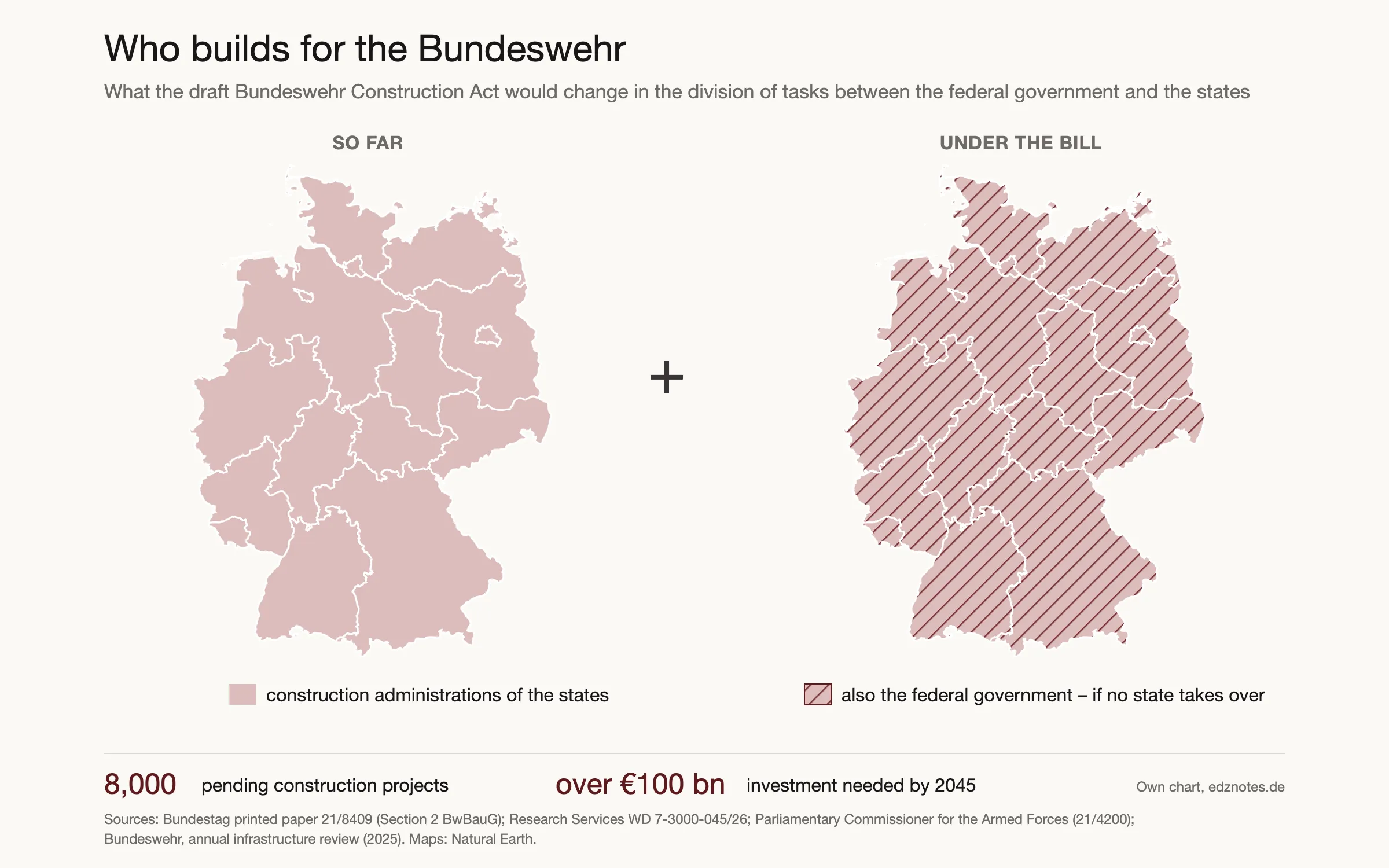
On 2 November, the Bundestag’s Defence Committee heard experts on the Bundeswehr Infrastructure Acceleration Act (German Bundestag, 2026a (öffnet in neuem Tab)). The bill is intended to ensure that barracks, depots, training areas and port facilities are built more quickly. The need is great: 8,000 construction projects are pending (Parliamentary Commissioner for the Armed Forces, 2026 (öffnet in neuem Tab)), and the Bundeswehr expects investment needs of over €100 billion by 2045 (Bundeswehr, 2025 (öffnet in neuem Tab)). The law mainly targets procedures – weighing of interests, approval, legal process – and allows the federal government to build itself. That construction should be faster is hardly in question; the Bundesrat also welcomes the project in principle. The dispute concerns two other questions: how far the federal government may build and plan in the states itself – and where construction takes place, i.e. on which land and at the expense of which other uses. Both questions arise particularly clearly in northern Germany, where ports, naval bases and protected coastal waters meet.
Why construction has become the bottleneck
Money is currently not the scarcest resource for the Bundeswehr, as the analysis of the 2027 defence budget has shown. Two other things are scarce: the capacity to build so much, and the space to do it.
The development of the figures shows how big the task is. In June 2025, the Defence Ministry put the need at over €67 billion into the 2040s (Parliamentary Commissioner for the Armed Forces, 2026 (öffnet in neuem Tab)); half a year later, the Bundeswehr was already expecting over €100 billion by 2045, including measures for the climate targets (Bundeswehr, 2025 (öffnet in neuem Tab)). State Secretary Sebastian Hartmann confirmed the order of magnitude at the first reading in the Bundestag (German Bundestag, 2026b (öffnet in neuem Tab)). In 2025, the Bundeswehr invested around €2.35 billion in buildings (Federal Ministry of Defence, 2026a (öffnet in neuem Tab)). According to the Federal Government, future needs exceed the previous construction volume many times over (Federal Government, 2026 (öffnet in neuem Tab)). Spread evenly over the roughly 20 years from 2026 to 2045, the over €100 billion would amount to just over €5 billion a year – about twice the €2.35 billion of 2025. The total need also includes measures for the climate targets, and including maintenance, almost €4 billion went into infrastructure in 2025. That the government speaks of a multiple suggests that a large part of the need will arise in the next few years – the ministry is aiming for war-readiness by 2029 (Federal Ministry of Defence, 2026a (öffnet in neuem Tab)). A breakdown of the infrastructure to be built by year is (so far) missing from the published documents.
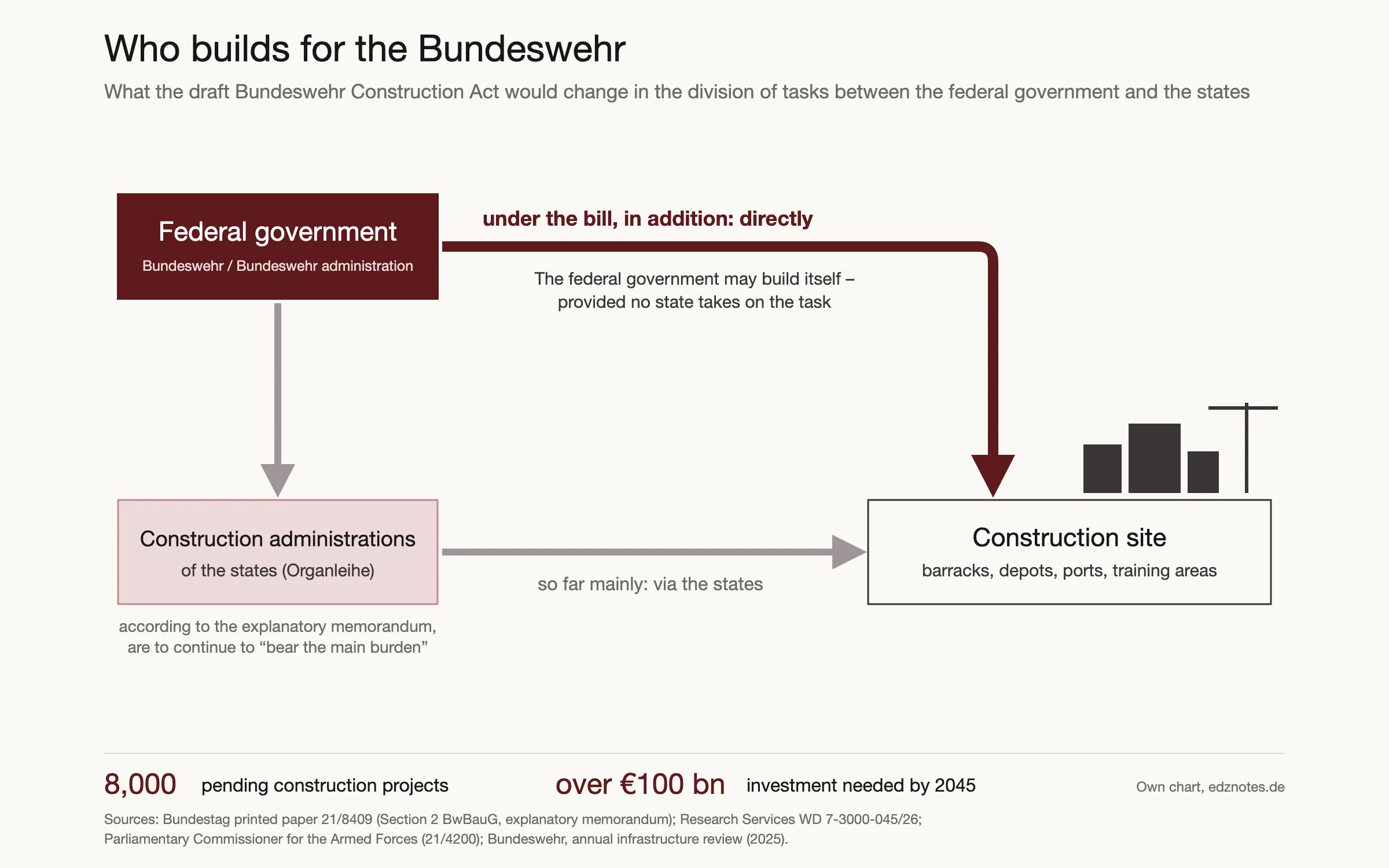
So far, construction has mainly been carried out not by the Bundeswehr itself, but by the construction administrations of the states, which act for the federal government and under its technical instructions by way of so-called Organleihe, the lending of state authorities to the federation (Research Services, 2026 (öffnet in neuem Tab)). In the Federal Government’s assessment, even with a maximum increase they might not be able to meet the need in time (Federal Government, 2026 (öffnet in neuem Tab)). A case from Schleswig-Holstein shows how much depends on coordination between the federal government and the state: in Jagel, a building erected in 2023 could not be occupied until the end of April 2025 because of minor outstanding work, as the Bundeswehr had evidently involved the responsible state construction administration too late – according to the report, a problem in the Bundeswehr’s own processes (Parliamentary Commissioner for the Armed Forces, 2026 (öffnet in neuem Tab)).
Even where construction capacity exists, space is short. The Defence Ministry writes that the few remaining development areas on existing sites will “by far not be sufficient” (Federal Ministry of Defence, 2026a (öffnet in neuem Tab)). The Bundeswehr therefore needs additional land. In the official documents, the competition for it shows up mainly in two places. First, in former military land that municipalities had earmarked for their own projects – from individual infrastructure measures to the “development of entire new urban districts” (Federal Ministry of Defence, 2026b (öffnet in neuem Tab)). Second, in the protection zones around military facilities, where building and use are only permitted to a limited extent; according to the Bundesrat, in Saxony, for example, they overlap with residential, commercial and wind energy areas (Bundesrat, 2026a (öffnet in neuem Tab)).
The law targets these two bottlenecks – and that is also where the disputes lie: who builds, and where.
What changes: three levers
Priority. The construction and operation of facilities for the Bundeswehr and for allied armed forces are to be in the “overriding public interest”. This regularly gives them particularly great weight in decisions involving the weighing of interests and the exercise of discretion. If other interests are also in the overriding public interest, the bill requires a case-by-case assessment (Federal Government, 2026 (öffnet in neuem Tab)).
Who builds. A new Bundeswehr Construction Act allows the federal government to carry out construction tasks itself – through the Bundeswehr administration or a company of its own – unless a state takes on the task under an agreed procedure. According to the explanatory memorandum, the states are to continue to “bear the main burden”. Because the Basic Law only allows construction to be transferred to the Bundeswehr administration by a law requiring the consent of the Bundesrat, the bill is designed as a consent law (Federal Government, 2026 (öffnet in neuem Tab)).
Fewer hurdles. Legal action against Bundeswehr construction projects is no longer to hold them up automatically; a construction halt will only be possible through interim relief. In future, the Federal Administrative Court will decide on selected disputes with the federal government, for example on protection zones, military airfields and land acquisition, at first and final instance. Under nature conservation law, until the end of 2035 the Bundeswehr may compensate for interventions on land used exclusively for defence by making an increased replacement payment instead of offsetting them; in future, the Defence Ministry or the Bundeswehr itself will decide on exemptions under species protection law for defence projects. For land acquisition and protection zones, a three-month deadline, extendable once, applies to consultation with the states; after that, it is presumed that there are no objections (Federal Government, 2026 (öffnet in neuem Tab)).
The Federal Government’s own figures show where these deadlines take effect: of the land acquisition procedures from 2019 to 2025, around 60 per cent were completed within three months anyway; for protection zones, only around one in seven; there, most were finished within six months, some took up to 36 months (Federal Government, 2026 (öffnet in neuem Tab)). Whether new barracks and depots are completed faster, however, is likely to depend less on such deadlines than on who plans and builds.
Where the federal government and the states disagree: powers and land
On 25 September, the Bundesrat welcomed the project in principle but called for changes (Bundesrat, 2026a (öffnet in neuem Tab)). The Federal Government rejected ten of its proposals and adopted three largely or in substance (Federal Government, 2026 (öffnet in neuem Tab)). Most of the points of dispute fall under two questions.
How far the federal government may go. The Bundesrat wants clarification of which construction tasks the federal government will take on itself in future and what a new federal construction administration or a federal construction company is to do in relation to the state construction administrations. The Federal Government rejects this: naming the tasks in the law already would undermine a procedure agreed with the states. The same applies to the special rights: according to the states, the overriding public interest should only apply to projects that serve defence – not, for example, to inner-city sports facilities, civilian residential buildings, day-care centres or car parks. The Federal Government counters that all Bundeswehr buildings serve defence, “including, for example, sports facilities and car parks”. The states also want to retain their responsibility in environmental law. In their view, replacement payments for interventions in nature should be handled by the states’ established bodies, not by a body designated by the Federal Environment Ministry. They want to delete the changes to water law entirely – including the provision that land used by the military should only exceptionally be newly designated as drinking water protection areas; the Bundeswehr’s existing participation rights are sufficient. The Federal Government rejects both.
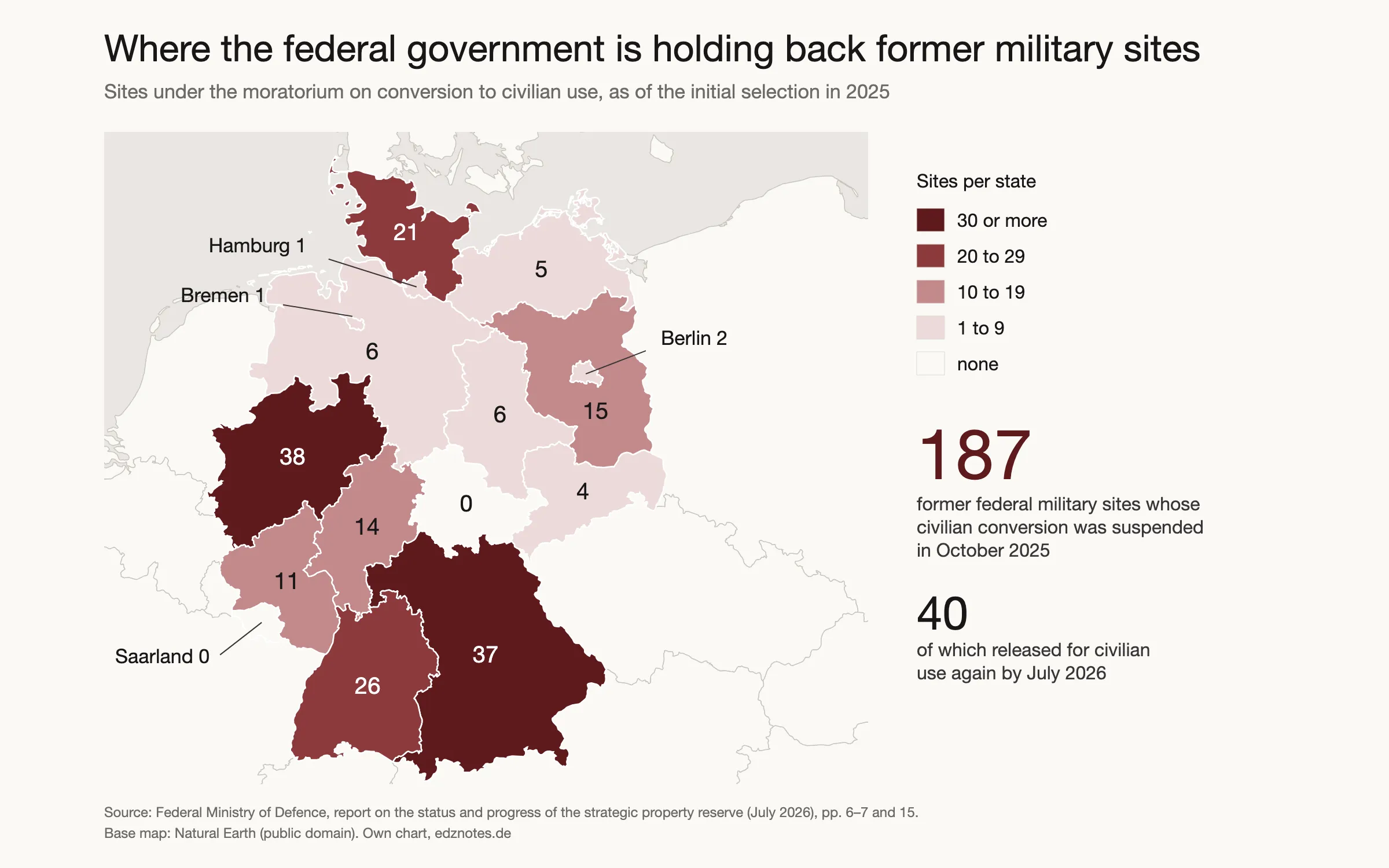
Where construction takes place. A decision by the Defence Ministry shows how scarce land is: since October 2025, the conversion of former military land to civilian use has been suspended; this initially affected 187 sites owned by the Institute for Federal Real Estate (BImA), of which the Bundeswehr had released 40 again by July 2026 (Federal Ministry of Defence, 2026b (öffnet in neuem Tab)). The bill takes up the question of land. If a plot is designated for defence purposes, it is removed from the municipality’s planning authority – following a concession by the Federal Government, until the end of military use. Former federal military plots that are not yet in civilian use and whose military use was given up no more than ten years ago are to be able to be dedicated to military use again without consultation. The states warn that municipalities typically prepare such land for civilian use over years and with urban development funding. The Federal Government wants to exempt land for which a development plan or land-use plan has been initiated or adopted, and to introduce a one-month consultation for the rest; it rejects an exemption for land that has received funding (Federal Government, 2026 (öffnet in neuem Tab)).
In the Bundestag, State Secretary Sebastian Hartmann (SPD) presented the bill of the CDU/CSU–SPD Federal Government; the CDU/CSU also explicitly supports it. The Greens warn against shifting decisions into “inappropriate duplicate structures” of the Defence Ministry, for example in species protection, and argue for clear deadlines for the state authorities (German Bundestag, 2026b (öffnet in neuem Tab)). The final word, however, lies with the Bundesrat: without its consent, the law will not enter into force.
A look at northern Germany
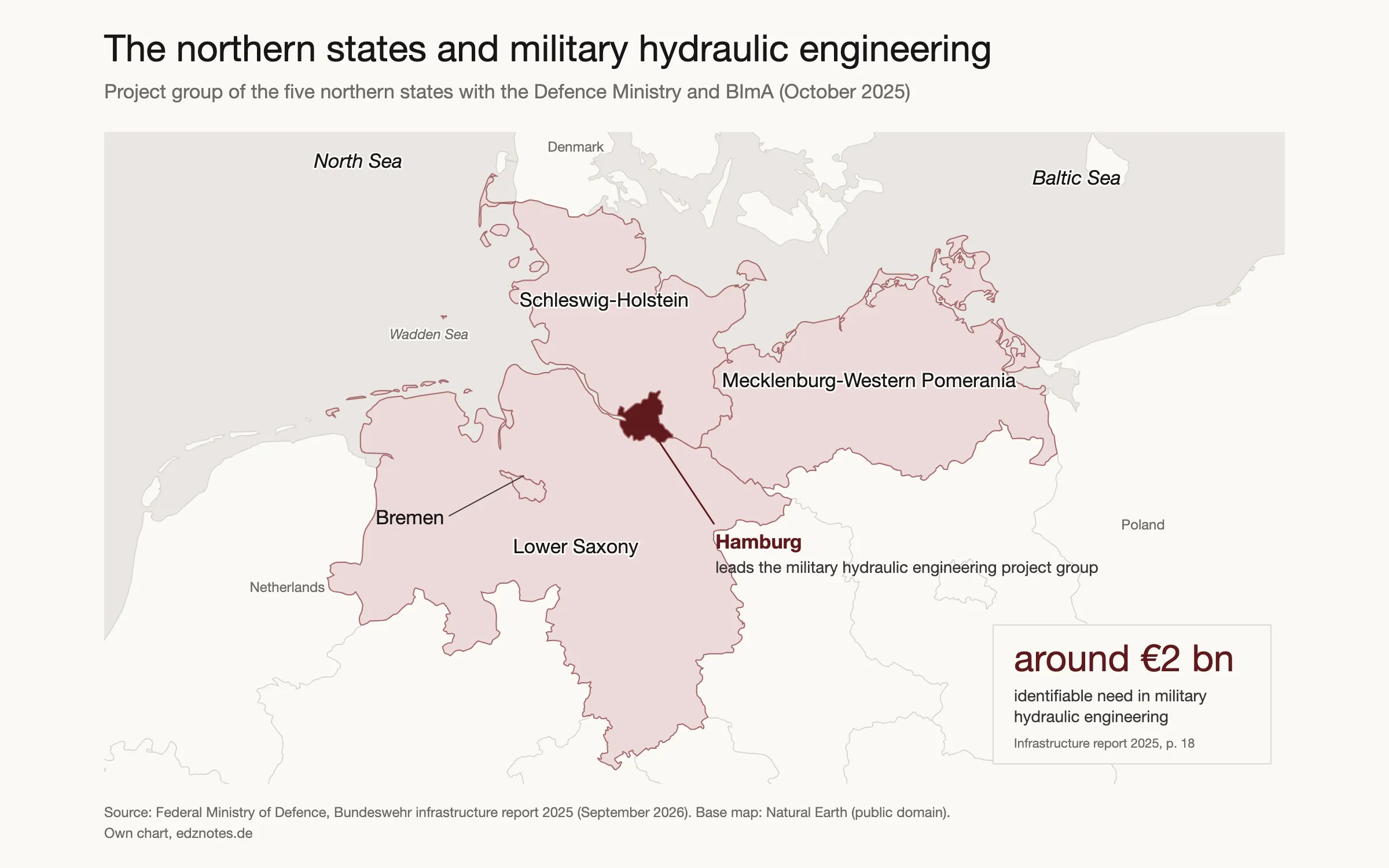
The explanatory memorandum of the bill explicitly mentions the expansion of seaports, airfields and air surveillance facilities. As a “logistics hub” for the deployment and supply of NATO forces, Germany plays a decisive role (Federal Government, 2026 (öffnet in neuem Tab)). For the coastal states with their ports and naval bases, this is not an abstract question. In October 2025, the five northern states – Bremen, Hamburg, Mecklenburg-Western Pomerania, Lower Saxony and Schleswig-Holstein – agreed with the Defence Ministry and BImA to manage military hydraulic engineering tasks jointly in a project group; the identifiable need is around €2 billion. Hamburg leads the group (Federal Ministry of Defence, 2026a (öffnet in neuem Tab)). The northern states are thus pooling their expertise across state borders – a route that the new law does not rule out, but does not map out either. For barracks, depots and training areas, it remains open whether they will expand their construction administrations in a similar way or leave more tasks to the federal government, which in future may build itself if no state takes on the task.
The difference from inland regions is clearest in a provision that has not so far been raised in the plenary debates of the Bundestag and the Bundesrat: until the end of 2035, declarations of marine protected areas are not to be allowed to restrict military uses in coastal waters (Federal Government, 2026 (öffnet in neuem Tab)). The Bundesrat’s Environment Committee considered this too far-reaching: the protected areas in Schleswig-Holstein’s coastal waters regularly belong to the European Natura 2000 network, and a blanket privilege could endanger the World Heritage status of the Wadden Sea (Bundesrat, 2026c (öffnet in neuem Tab)). In the Bundesrat plenary, neither the deletion nor the milder alternative – under which military use would merely be given “consideration” when designating protected areas – found a majority (Bundesrat, 2026b (öffnet in neuem Tab)). For now, the question therefore lies with the Bundestag.
What should follow
First: the federal government and the states should disclose where military needs and civilian planning compete for the same land. The Federal Government rejects an exemption for land prepared for civilian use with urban development funding, because the Bundeswehr could only identify such cases with disproportionate effort; unlike land-use plans, it is not usually involved in funding procedures. The states that approve this funding, by contrast, know the land. A notification by the states would make the exemption manageable and show where civilian planning and defence actually collide.
Second: the Bundestag should write a review into the law. The explanatory memorandum states explicitly: “No evaluation is planned.” Several exemptions in environmental and nature conservation law, however, expire at the end of 2035. A regular report to the Bundestag – on the duration of procedures, legal action and replacement payments, but also on who builds which projects and to what extent – would show which exemptions are working – and would make the dispute over the division between the federal government and the states more objective without fixing it rigidly in the law, which the Federal Government rejects.
Third: the exemption for coastal waters should be examined separately in the parliamentary process. The hearing on 2 November offers an opportunity to clarify whether an obligation to take military use into account is sufficient to secure exercises and facilities without risking conflicts with European nature conservation law and the Wadden Sea World Heritage Site.
Conclusion
The law answers the question of how the Bundeswehr can obtain approvals and judgments faster. It only partly answers the questions of who will build all this and where. Space in particular is not decided in the Federal Law Gazette but plot by plot, in talks with the states and municipalities. Whether the law works will be shown by barracks and port facilities ready for occupation – and the legislator should set itself a review date for this.
The current status of the procedure is tracked by the legislation monitor (in German).