Who defends Germany against cyberattacks? What the Act to Strengthen Cybersecurity changes and what remains open
Translated from the German original on 19 November 2026.

Key points
- Under the Act to Strengthen Cybersecurity, the Federal Criminal Police Office (BKA) and the Federal Police will be allowed to intervene in IT systems that pose a cyber threat, including victims' systems that have been misused and, if necessary, systems abroad. The BSI receives additional protective powers.
- The new powers of intervention go to the police, not to the Bundeswehr. The Federal Government assigns these cases to the prevention of threats, which is fundamentally a matter for the states, and relies on existing federal competences. How far these extend is disputed; the coalition does not have its own two-thirds majority to amend the Basic Law.
- The bill obliges the authorities to coordinate at individual points. It does not contain a common rule on who takes the lead in an attack, even though the BND and the Office for the Protection of the Constitution are also receiving new powers in cyberspace at the same time. In a resolution, the Committee on Internal Affairs calls for a clear division of roles in the next cybersecurity strategy.
- It is unclear whether the authorities will find the specialists they need: for the BKA alone, the bill estimates 264 additional staff; the requirement is to be offset within the Interior Ministry's budget. The Interior Ministry must review whether the act is effective by 2029; this evaluation was added by the Committee on Internal Affairs.
- Many measures have to be implemented by companies: they are obliged to cooperate when the BKA or the Federal Police have data traffic diverted or systems shut down; operators of critical facilities are to connect their attack detection to the BSI. The Federal Government estimates the cost to business at around €10 million a year.
- After the vote in the Bundestag, it is mainly the Bundesrat, the Federal Government in coordinating the authorities and the Bundestag through the budget that can still make adjustments.
On 12 November, the Bundestag adopted the Act to Strengthen Cybersecurity in the version amended by the Committee on Internal Affairs, with the votes of the CDU/CSU and SPD against the AfD, the Greens and the Left (German Bundestag, 2026b (öffnet in neuem Tab)). The Bundesrat still has to give its consent. Federal Interior Minister Alexander Dobrindt opened the first reading in June by saying that they were paving “the way for a milestone in Germany’s security architecture”: “With this bill, we are quite simply flipping the switch: from investigation to defence.” (Plenary record 21/86, 2026 (öffnet in neuem Tab), p. 10417) Already after the cabinet decision in May, he had announced: “We will be able to disrupt attackers and destroy their infrastructure.” (ZDF, 2026 (öffnet in neuem Tab))
Authorities can already take certain defensive measures; the BSI, for example, may have harmful data traffic diverted. The act considerably extends these options, above all to include targeted interventions in IT systems from which an attack originates. This raises a question the act barely addresses: who actually defends Germany against attacks online, and who coordinates with whom?
What the act allows
The bill mainly amends the BSI Act, the Federal Criminal Police Office Act and the Federal Police Act (Federal Government, 2026a (öffnet in neuem Tab), pp. 7–24). The BKA and the Federal Police will be allowed to prohibit the operation of IT systems, divert or block data traffic and read, delete or alter “threat-related data”. This means, for example, malware, attack tools or data stolen in an attack. The precondition is a specific cyber threat. The authorities may also intervene in the computers of ordinary users that attackers have secretly taken over in order to continue their attacks from there. The measures are not directed against uninvolved parties. But if, for example, diverted data traffic runs through their systems, the measure may still take place if this cannot be avoided (Federal Government, 2026a (öffnet in neuem Tab), pp. 7 f., 19 f., 46). The Federal Police may use the powers only to prevent threats, not for criminal prosecution. The Committee on Internal Affairs extended the BKA’s powers further: it will also be allowed to use them when attackers use IT systems to bring about a danger in the physical world, for example explosive or incendiary devices controlled via the internet, or drone control units (Committee on Internal Affairs, 2026 (öffnet in neuem Tab), pp. 2, 15).
The BSI will be able to instruct more service providers to divert harmful data traffic and, at the request of affected organisations, to search for attackers even when they are only just establishing themselves in systems (hib, 2026a (öffnet in neuem Tab)).
Systems abroad may also be affected. Whether such an intervention is permissible must then also be examined under international law (Heckmann, 2026 (öffnet in neuem Tab), p. 12). Dobrindt explicitly distinguishes the project from a “hack back”, which he understands as a retaliatory strike: “This is not a hack back, ladies and gentlemen. This is an appropriate response to hybrid threats.” The Left and the Greens consider this a mere relabelling (Plenary record 21/86, 2026 (öffnet in neuem Tab), pp. 10418, 10421, 10424).
Why the police get new powers and not the Bundeswehr
Politically, it would also have been conceivable to place the defence against state-directed attacks more firmly with the Bundeswehr, which has its own capabilities in the Cyber and Information Domain Service. The Bundestag’s Research Services broadly distinguish between cyber defence by the armed forces, to which the rules governing their deployment apply, and civilian cyber defence, which must be measured against the law governing the security authorities (WD 3, 2026 (öffnet in neuem Tab), pp. 10 f.). Under the Basic Law, the prevention of threats is fundamentally a matter for the states; the federal government may only act where it has its own competence. How far these competences extend in active cyber defence is disputed (WD 3, 2026 (öffnet in neuem Tab), pp. 11–16).
The Federal Government relies on the existing competences of the BKA, the Federal Police and the BSI (Federal Government, 2026a (öffnet in neuem Tab), p. 26). An amendment to the Basic Law, which earlier debates had pointed to, is something the coalition could not adopt on its own: it does not have a two-thirds majority in the Bundestag and would also need one in the Bundesrat. Sven Herpig of the think tank Interface sees this as the reason for the route chosen (Herpig, 2026 (öffnet in neuem Tab), p. 7).
The Bundeswehr receives no new powers of intervention under this act. Its existing tasks remain unaffected. What is new is that the BKA and the Federal Police must pass information to it when defence is affected, and that the BSI includes the armed forces in its information and in the protection of communications technology. Responsibility for defence, the explanatory memorandum states, “remains unaffected with the armed forces” (Federal Government, 2026a (öffnet in neuem Tab), p. 60).
Where the line becomes blurred
An example from the same explanatory memorandum is revealing. The BKA is to be responsible, among other things, when an attack originates from or is supported by a foreign power. An effect on defence could exist, for example, in the case of a serious attack on a manufacturer of military equipment (Federal Government, 2026a (öffnet in neuem Tab), p. 60). According to this example from the Federal Government, a state-backed attack on the defence industry would therefore be answered by a police authority, within the framework of threat prevention.
Parliamentary oversight also differs depending on the authority: for the Bundeswehr, there are the Defence Committee, the Parliamentary Commissioner for the Armed Forces and, in some circumstances, the consent of the Bundestag; for the BKA and the Federal Police, there are not (WD 3, 2026 (öffnet in neuem Tab), p. 19). For them, judicial and data protection controls apply; the bill also extends notification and logging obligations (Federal Government, 2026a (öffnet in neuem Tab), pp. 9 f., 22).
In parallel, the Bundestag has debated the reform of the law on the intelligence services. It too gives the BND and the Office for the Protection of the Constitution narrowly limited access to attackers’ IT systems (hib, 2026b (öffnet in neuem Tab)). In his statement for the hearing, Herpig warns that this creates “several operational pillars without clear prioritisation or coordination rules”, with the BfV, the BND and the Bundeswehr alongside the BKA, the BSI and the Federal Police (Herpig, 2026 (öffnet in neuem Tab), p. 5). The bill obliges the authorities to coordinate at individual points: if the BKA or the Federal Police divert data traffic, they must consult the BSI, and the BKA must notify the states concerned (Federal Government, 2026a (öffnet in neuem Tab), pp. 9, 17, 19 f.). It does not contain a common rule on who takes the lead in an attack and how conflicts are resolved. The coalition also sees the problem. Daniel Baldy (SPD) warned as early as the first reading: “With so many actors, we must not allow a muddle of competences to arise.” (Plenary record 21/86, 2026 (öffnet in neuem Tab), p. 10419)
The CDU/CSU, SPD and Greens therefore adopted a resolution in the Committee on Internal Affairs and, on 12 November, also in the Bundestag (German Bundestag, 2026b (öffnet in neuem Tab)). It calls on the Federal Government to expand the National Cyber Defence Centre into the central platform on which incidents are first coordinated across authorities, and to set out a clear division of roles and tasks in active cyber defence in the forthcoming cybersecurity strategy (Committee on Internal Affairs, 2026 (öffnet in neuem Tab), pp. 8–10). A resolution cannot legally bind the government. The rule on who takes the lead in an attack will thus be set out in a strategy, not in the law.
Can the authorities actually do this?
Powers alone do not fend off an attack. Intervening in other people’s systems takes specialists, tools and practice. The bill estimates 264 additional staff at the BKA and, once fully built up, around €39 million a year for personnel and technology, 90 posts at the Federal Police by 2031 and 21 posts at the BSI by 2030. The additional requirement is to be offset within the Interior Ministry’s budget; the Bundestag must provide it in the coming budgets (Federal Government, 2026a (öffnet in neuem Tab), pp. 2 f., 28–30). The bill does not answer whether so many IT specialists can be recruited for the BKA and the Federal Police.
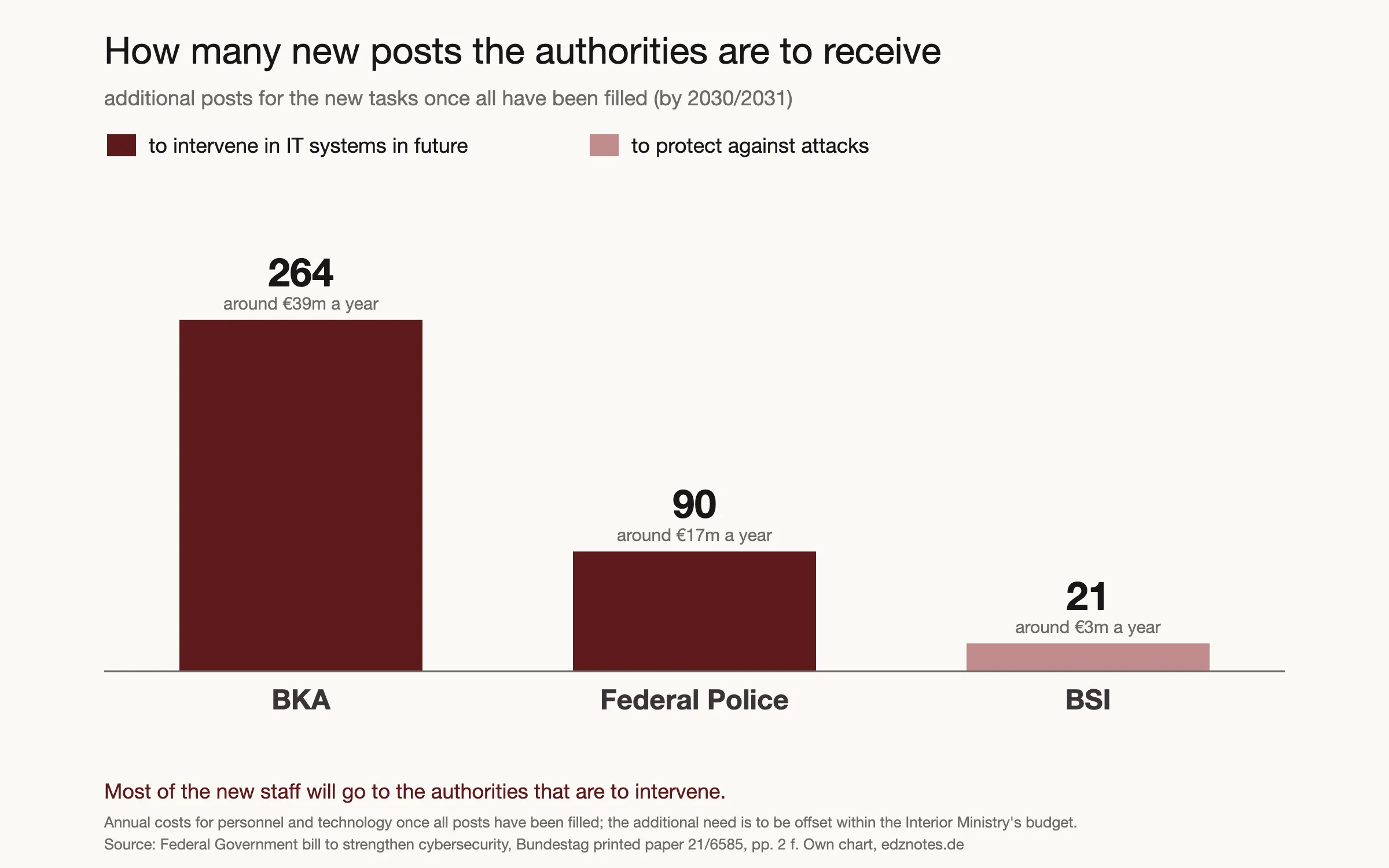
For the new search for attackers who have established themselves in systems, the BSI initially plans three investigations a year; an increase is planned, and methods and staff from existing incident handling will also be used (Federal Government, 2026a (öffnet in neuem Tab), p. 29). Herpig considers this too little and the expansion of around 350 posts for intervention measures at the BKA and the Federal Police “politically and strategically questionable”. He sees the real weaknesses in the protection of the federal government’s own systems and refers to a 2025 report by the Federal Court of Auditors on federal IT security (Herpig, 2026 (öffnet in neuem Tab), pp. 6 f.).
What this means for companies
The powers go to the authorities, but many measures are implemented by companies. If the BKA diverts data traffic, the companies concerned are obliged to cooperate. The Federal Government expects around 600 such cases a year, each requiring around 100 hours of work. In addition, there are an estimated 300 cases in which the BKA prohibits the operation of a system; as an example, the explanatory memorandum cites shutting down companies’ infected servers (Federal Government, 2026a (öffnet in neuem Tab), p. 35). The largest item is caused by an obligation for operators of critical facilities: they are to use attack detection systems and connect them continuously to the BSI. The Federal Government assumes around 2,100 facilities. In total, it estimates the cost to business at around €10 million a year and a one-off sum of around €4.4 million (Federal Government, 2026a (öffnet in neuem Tab), pp. 3, 31–34). In the resolution of the Committee on Internal Affairs, the Federal Government is also called upon to involve business more closely and more quickly in situation reports (Committee on Internal Affairs, 2026 (öffnet in neuem Tab), p. 10).
For manufacturers of military equipment, there is the added point that, according to the example in the explanatory memorandum, the BKA would be responsible in the event of a state-backed attack, not the Bundeswehr (Federal Government, 2026a (öffnet in neuem Tab), p. 60). In future, several authorities may approach a company in the event of an attack; who its point of contact is then depends on who is responsible, and there is as yet no common rule for this.
The dispute over oversight
For interventions without consent that enable data to be collected on privately used IT systems, the bill generally provides for a court order and, in urgent cases, subsequent confirmation. For other systems, this special requirement does not apply (Federal Government, 2026a (öffnet in neuem Tab), pp. 20 f.). The Bundesrat called for it to be extended to non-private systems in the case of the BKA, because private and commercial use often cannot be separated. The Federal Government rejected this: the distinction follows the scope of protection of the fundamental right to the confidentiality and integrity of information technology systems. It only undertook to specify which court is responsible for two BKA measures and under which procedure it decides (Federal Government, 2026b (öffnet in neuem Tab), p. 5). The Committee on Internal Affairs did not follow the Bundesrat’s demand, but added a fallback rule: if it cannot be established with certainty whether a system is used privately, it is deemed private, and the requirement of a judicial order applies. It also clarifies that reading, deleting or altering data is generally the most serious intervention and that milder means such as diverting data traffic or shutting down a system take precedence (Committee on Internal Affairs, 2026 (öffnet in neuem Tab), pp. 14 f.).
At the hearing on 5 October, assessments diverged, but even supporters called for improvements. The police union GdP welcomes the bill, but suggests an evaluation and proposes bundling coordination through a further development of the National Cyber Defence Centre (GdP, 2026 (öffnet in neuem Tab), pp. 5 f.). According to the Bundestag’s report, BKA President Holger Münch welcomed the new tasks (German Bundestag, 2026a (öffnet in neuem Tab)). The legal scholar Dirk Heckmann calls for a judicial order for every covert access without effective consent to personally relevant systems used by the person concerned (Heckmann, 2026 (öffnet in neuem Tab), pp. 16 f.). Constanze Kurz and Dirk Engling of the Chaos Computer Club consider the measures “too invasive”: anyone who keeps security vulnerabilities open for interventions also endangers all other users, and interventions could hit uninvolved systems (Kurz/Engling, 2026 (öffnet in neuem Tab), pp. 2 f., 7).
The bill did not provide for a separate evaluation. The Federal Government considered the consequences to be “essentially predictable” and referred to existing controls, reporting obligations and statistical recording (Federal Government, 2026a (öffnet in neuem Tab), pp. 10, 42 f.). The National Regulatory Control Council disagreed: under the Federal Government’s own rules, the project is subject to mandatory evaluation (NKR, 2026 (öffnet in neuem Tab), pp. 75 f.). The Bundesrat’s Economic Affairs Committee and, at the first reading, the AfD had also called for a review (Bundesrat, 2026a (öffnet in neuem Tab), p. 4; Plenary record 21/86, 2026 (öffnet in neuem Tab), p. 10423). The Committee on Internal Affairs made improvements: the Interior Ministry must examine by 1 January 2029 at the latest whether the new rules are effective, and report to the Bundestag no later than six months afterwards. According to the explanatory memorandum, the review will examine, among other things, the frequency and results of the interventions, the consequences for uninvolved third parties and cooperation between the authorities, with the involvement of academia. The explanatory memorandum does not set fixed targets; it speaks of “suitable qualitative criteria” (Committee on Internal Affairs, 2026 (öffnet in neuem Tab), pp. 8, 16).
What is still possible now
After the vote in the Bundestag, the Bundesrat will consider the act a second time, according to its agenda on 20 November (Bundesrat, 2026b (öffnet in neuem Tab), item 61). How it works in practice will be decided after that.
First, the Bundesrat must give its consent. It can call on the Mediation Committee and there, for example, put forward again its demand for a judge also for non-private systems; the new fallback rule only partly meets its concerns. A mediation procedure may bring further changes.
Second, the Federal Government can improve operational coordination within the existing powers and agree binding procedures with the states, for example in the National Cyber Defence Centre, as the police union GdP proposes. This is exactly what the resolution of the Committee on Internal Affairs also calls for. Whether the forthcoming cybersecurity strategy sets out a clear division of roles will show how seriously this is meant.
Third, the Bundestag retains influence through the budget. The new posts must be provided in the coming budgets. In doing so, the Bundestag can demand reports on the use and success of the new powers, including from the BKA. At the latest with the evaluation report, which must be available by mid-2029, it can make adjustments.
Fourth, the constitutional question remains in the medium term. As long as the Basic Law does not regulate defence below the threshold of a state of defence more clearly, this act too is built onto existing competences, and the question of what role the Bundeswehr should play below the threshold of a state of defence remains open.
Conclusion
The act gives German authorities additional legal options to disrupt an ongoing attack instead of merely investigating it. The Federal Government has chosen a solution that requires no amendment to the Basic Law. It distributes defence across several authorities and regulates their interaction only at individual points. In the Committee on Internal Affairs, the coalition added an evaluation by 2029; the Federal Government is only to set out a clear division of roles in its cybersecurity strategy. Whether Germany is better protected online as a result will not be shown by the text of the law, but by whether the authorities find the specialists they need and whether it is clear who acts in an emergency.