What the withdrawal of 5,000 US troops means for Germany's security
Translated from the German original on 19 November 2026.
Key points
- The announced withdrawal of a US brigade – according to media reports, the Stryker unit in Vilseck – and the reported cancellation of a long-range missile battalion do not directly endanger Germany's security, but they make existing dependencies on American presence and political reliability more visible.
- What matters is not the figure of 5,000 troops, but which capabilities would be affected: operational mobility, logistics, command, deterrence, responsiveness and sustainability.
- Particularly relevant is the uncertainty about specialised US capabilities such as long-range strike, rapid reinforcement and well-established command and support structures in Germany.
- The move reinforces doubts as to whether American security support will remain predictable in a crisis if military presence appears increasingly subject to political conditions.
- Germany therefore needs more national and European capacity to act – not as a substitute for the USA, but as insurance against uncertainty within an alliance that remains indispensable.
The Pentagon has announced the withdrawal of a brigade from Germany. According to information obtained by BR (öffnet in neuem Tab) from US Army circles, it concerns the Stryker unit of the 2nd Cavalry Regiment at Rose Barracks in Vilseck, Bavaria; the unit was initially not officially confirmed. At the same time, it was reported that the planned stationing of a long-range missile battalion in Germany would not go ahead either. This cancellation came as no surprise, said Defence Minister Boris Pistorius: according to the Federal Ministry of Defence (öffnet in neuem Tab), the earlier agreement between Joe Biden and Olaf Scholz was never confirmed by the Trump administration. The debate gained additional weight when President Donald Trump (öffnet in neuem Tab) held out the prospect of an even larger withdrawal in Florida shortly afterwards. “We’re going to cut way down. And we’re cutting a lot further than 5,000,” he told reporters.
Militarily, what matters is less the number of troops than the capability that would be lost with the unit concerned. An earlier reduction shows how little troop numbers alone reveal: under Obama (öffnet in neuem Tab), the US presence in Europe fell from around 80,000 to about 68,000 troops from 2012 onwards. At the same time, other capabilities were expanded or given greater weight – including missile defence, maritime presence, special forces and rotational units. So it was not only a matter of reduction, but of restructuring. In the current case, by contrast, a specific unit with a clear operational function would be lost.
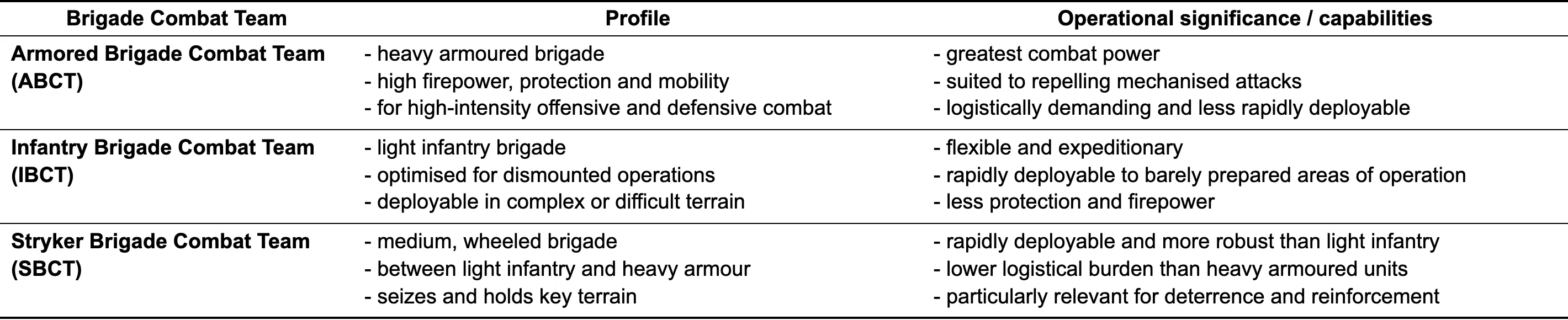
The 2nd Cavalry Regiment (öffnet in neuem Tab) is the only American Stryker unit with a brigade-equivalent function permanently stationed in Germany and thus a central component of the US presence in Europe. Among the US Army’s three types of brigade combat team, it sits between light infantry and heavy armour. It serves American deterrence and reinforcement planning on NATO’s eastern flank. Its withdrawal would therefore leave an operational gap (see Figure 1).
The reported cancellation of the planned American Long-Range Fires Battalion could be even more significant. The earlier agreement with the Biden administration provided for ground-launched Tomahawk cruise missiles, SM-6 missiles and, in future, hypersonic weapons from 2026 (öffnet in neuem Tab). This calls into question not just a single stationing decision, but a capability that European states have so far possessed themselves only to a limited extent: longer-range conventional precision strike. If the cancellation stands, it would therefore be more significant (öffnet in neuem Tab) for security policy than the number of troops to be withdrawn suggests.
At least as important as the military side is the political context: the announced withdrawal follows marked tensions (öffnet in neuem Tab) between Washington and Berlin over the Iran war. Friedrich Merz had previously said that the USA was being “humiliated (öffnet in neuem Tab)” by Iran’s leadership and evidently had no convincing strategy (öffnet in neuem Tab) in the negotiations with Iran. This was not a fundamental turn away from Washington, but a visible political distancing from the American line – in a conflict that Trump has to present domestically (öffnet in neuem Tab) as an expression of his resolve, his deterrence policy and his personal authority. In an administration that understands alliance policy in strongly transactional (öffnet in neuem Tab) terms and places great weight on visible loyalty, such a position does not remain without consequences.
Under Trump’s alliance policy (öffnet in neuem Tab), partners must not only contribute militarily or make economic concessions. They must also frame these contributions in a way that allows Trump to present them as proof of his own strength, negotiating power and international recognition. Anyone who publicly questions American priorities or contradicts Trump’s account of a conflict apparently risks not only diplomatic irritation, but political pressure in other policy areas as well – from trade to security presence.
The fact that Trump made similar threats against Italy (öffnet in neuem Tab) and Spain (öffnet in neuem Tab) at the same time reinforces this impression. There, too, the issue was not classic disloyalty to the alliance, but that European partners did not want to fully support the American line in the Iran war. American security presence thus seems to be tied less to alliance loyalty in the classic sense than to political allegiance – combined with the implicit expectation that American priorities will be supported even when they run counter to one’s own reservations or interests.
There is also a structural difference that is often underestimated in the German security debate: the USA is central to Europe’s security, but it does not share Europe’s geographical vulnerability in the same way. Germany, Poland, France, the Baltic states and the Nordic countries lie in the same security space. For them, a war in Europe is not a distant crisis, but a direct threat to their own order. When a central ally ties its military presence more closely to its own interests, this calls previous security assumptions into question. How reliable is the American presence if diplomatic disagreements are directly linked to questions of military presence and joint defence capability?
For Germany, this question goes even further: what security functions does the USA perform here that Europe itself has so far been able to provide only to a limited extent?
From front line to hub
To put the withdrawal into context, a brief look back helps. After 1945, the American presence in Germany initially arose from the occupation regime. With the Cold War and the Federal Republic’s accession to NATO (öffnet in neuem Tab) in 1955, its function changed fundamentally: occupation became deterrence. American troops were thus not only military protection but also a political signal: an attack on Western Europe would have directly involved the USA.
After the end of the Cold War, Germany lost this direct role as a frontline state. The American presence shrank but did not disappear. Its function changed (öffnet in neuem Tab): Germany became less a forward line of defence than an operational hub (öffnet in neuem Tab) – a staging and logistics node for American operations.
US sites in Germany served not only European security, but also American operations far beyond Europe. Politically, this was not always uncontroversial, especially during the 2003 Iraq war: at the time, the Bundestag’s Research Services (öffnet in neuem Tab) explicitly examined whether and to what extent the Federal Government was permitted to grant the USA overflight rights and the use of American military bases in Germany. German sites also played a key practical role in the Gulf War and the Afghanistan deployments – for example in operations (öffnet in neuem Tab) DESERT SHIELD/STORM from 1990 to 1991 and ENDURING FREEDOM from 2001 to 2002, and in 2021 in the evacuations (öffnet in neuem Tab) from Kabul. In the Iran war, Euronews (öffnet in neuem Tab) also describes Ramstein Air Base as a command and coordination node for American operations in the Middle East.
For the initial question, what counts is therefore which functions run through these sites: command, deployment, training, supply, medical evacuation and support in a possible collective defence scenario. It is precisely such structures that generate speed in a crisis. And speed means political as well as military room for manoeuvre.
It is not only about troops, but about capabilities
The question is therefore not whether Germany can replace 5,000 US troops. It is whether Germany can replace the capabilities associated with the American presence – and whether the same deterrent effect would be maintained as a result.
The answer is mixed. Germany is not defenceless: today, the Bundeswehr has its own capabilities in air defence, airlift, reconnaissance, artillery and land warfare. Many of these, however, are still being built up, depend on foreign supply chains or do not exist in the depth that a major collective defence scenario would require. The possible withdrawal would therefore be less a personnel problem than a problem of reach, logistics, command capability and sustainability.
Military capability cannot be reduced to troop numbers or weapon systems in any case. In its 2018 capability profile (öffnet in neuem Tab), the Bundeswehr also follows a broader planning logic that considers materiel, personnel, infrastructure, operations, organisation and training together. Accordingly, modernisation meant not only procurement, but also filling “hollow structures” and building up new capabilities. In assessing military strength, what matters is whether armed forces can command, reconnoitre, protect, deploy, supply and sustain their assets.
The largest gap so far is in effect, i.e. the ability to engage enemy targets or to deter credibly. Germany does have an air-launched cruise missile in Taurus, and in MARS II and artillery systems such as the Panzerhaubitze 2000 and, in future, the RCH 155, it has precision-capable effectors. But this does not replace a permanently available ground-based long-range capability such as the planned American Long-Range Fires Battalion, whose stationing, according to reports, is no longer to go ahead. It is precisely here that a final cancellation would weigh particularly heavily.
On protection, Germany is better placed. The Bundeswehr can operate Patriot itself and is building up additional layers of air defence with IRIS-T SLM and Arrow 3. Air defence is therefore not an area that only works with US troops. The limitation lies rather in ammunition, spare parts, modernisation and the question of how long these systems can be sustained in a collective defence scenario.
On reconnaissance and command, German capability is growing but remains incomplete. SARah satellites, Heron TP, P-8A Poseidon and, in future, PEGASUS create a national foundation. What matters, however, is not the individual sensor, but the combination of situational picture, analysis, communication and command. It is precisely here that the American presence remains important, because it provides not only systems, but well-established command, reconnaissance and communication structures.
Support and sustainability are a further weak point. With the A400M, the C-130J and the multinational A330 MRTT fleet, Germany has national and shared transport, tanker and MedEvac capacities. In addition, there are CH-47F transport helicopters on order as well as new maintenance and ammunition projects. Much of this, however, will only take effect with a delay. And even existing equipment is only as strong as the logistics behind it: spare parts, maintenance, ammunition stocks, transport routes, permits, railway lines, bridges and ports.
The Federal Government’s National Security Strategy (öffnet in neuem Tab) also supports this view: national and collective defence is the Bundeswehr’s core mission; at the same time, critical dependencies are to be reduced and Germany’s own capacity to act strengthened. For the question of the withdrawal, this means: what matters is whether Germany can itself carry the capabilities and support structures behind the American presence.
The publicly visible procurement situation therefore presents a mixed picture. Since the Zeitenwende, Germany has been building up real capabilities. Many of them, however, are still being delivered, bound up in multinational arrangements or dependent on US and third-country ecosystems. It remains open whether this will produce a sustainable, integrated and politically available deterrence capability in the short term.
This dependency is well known – and politically relevant. If key systems rely on American software, mission data, updates, spare parts or communication networks, Washington can influence their operational readiness. Under Trump, it would thus not only be the withdrawal of American forces that becomes a source of uncertainty, but also the technical support ecosystem on which many European capabilities are based.
This does not mean that Washington would actually use these levers. It is enough that they exist – especially since, as described, the USA does not share Europe’s geographical vulnerability in the same way. European security therefore cannot depend permanently on key capabilities, supply chains and digital interfaces remaining politically available. Certain foundations of military capacity to act must be controllable at European level – not out of distrust of alliances, but because deterrence is only credible in an emergency if it does not depend at all times on external decisions.
History offers a precedent: in the Second World War, the USA supported Britain politically and materially even before entering the war itself, but only became an active participant after the attack on Pearl Harbor. This does not mean that alliances are worthless. But it shows that even close partners weigh risks differently as long as their own security is not directly affected to the same extent.
It does not automatically follow that Germany must replicate every American capability nationally on a one-to-one basis. Division of labour within the alliance is the very purpose of collective security. It becomes problematic where key capabilities become politically uncertain and Germany can only decide to a limited extent on deployment, stationing, resupply or availability. The real political question is therefore which capabilities Germany must maintain itself, which can be organised at European or NATO level and where dependencies should be consciously accepted. The aim is not maximum autarky, but a resilient capacity to act in a crisis.
The withdrawal is thus above all a question of political reliability. A troop redeployment would not in itself be unusual if it were strategically justified, coordinated and communicated comprehensibly. It becomes problematic where military presence appears negotiable as a response to diplomatic disagreements. Then it is no longer just a matter of military planning, but of the resilience of the alliance: can it withstand differing interests and translate them into compromises – or does security dependency become a means of political discipline?
Stocktaking from publicly available information
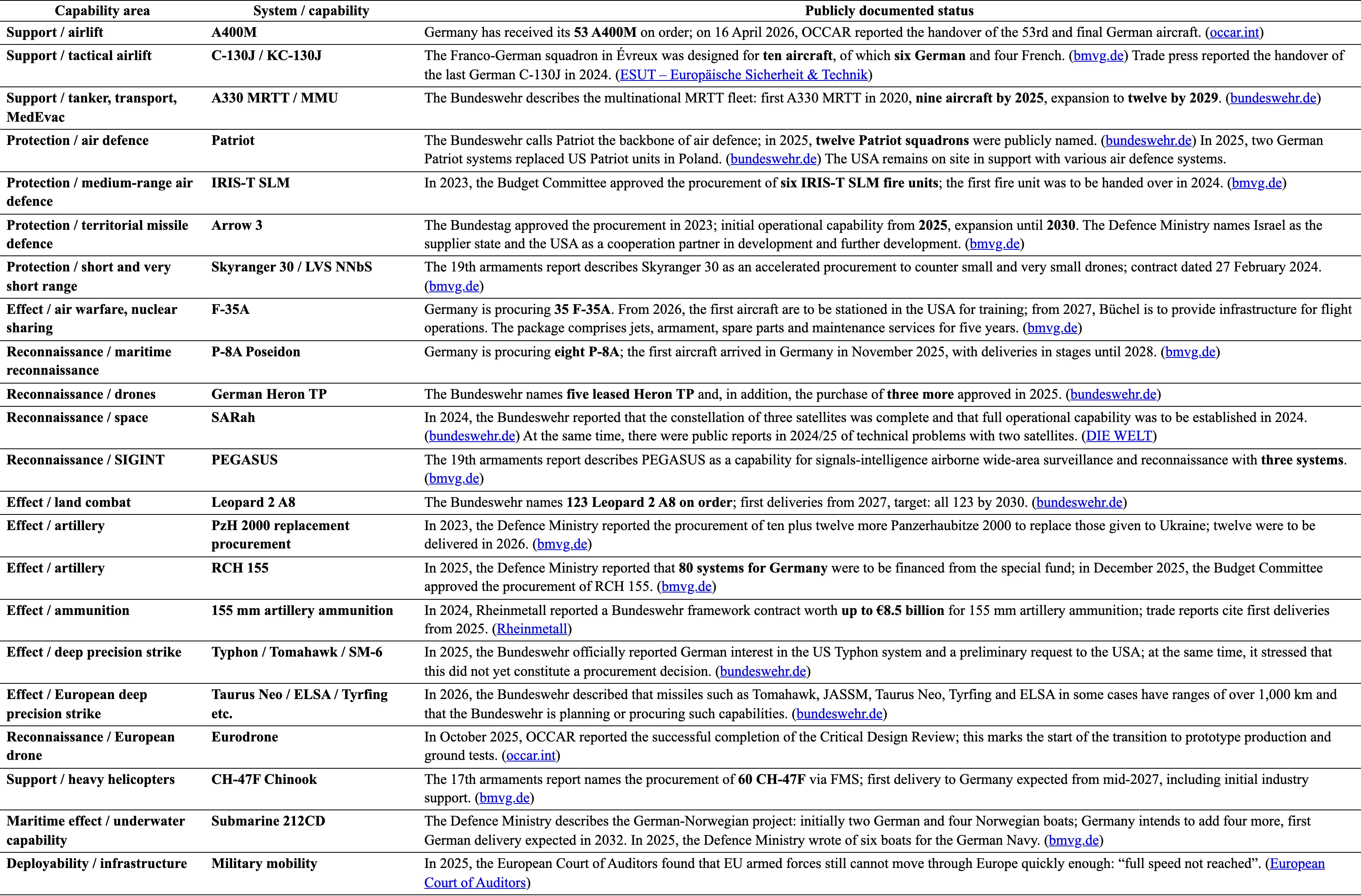
The following stocktaking shows Germany’s existing or commissioned capabilities and is based on publicly available information since the Zeitenwende. It cannot reflect full operational readiness or sustainability, because ammunition stocks, spare parts depots, software versions and specific availability can be viewed publicly only to a limited extent. It does show, however, which capabilities Germany is visibly building up, procuring or already operating (see Figure 2).
What Germany actually loses
Germany will probably not lose any single military capability completely as a result of the withdrawal announced so far. Nor would the pure personnel figure (öffnet in neuem Tab) automatically be the decisive bottleneck in a crisis. More serious is that a reduced US presence could affect capabilities that cannot be replaced or mobilised at short notice: operational materiel, ammunition, logistics, airlift, command capability and industrial sustainability.
The real loss therefore lies less in headcount than in redundancy, flexibility and predictability. If fewer US troops and possibly fewer specialised capabilities are available in Germany, this can affect exercises, rotations, command structures, logistical processes and speed of response. Not every one of these effects would be immediately visible. In a crisis, however, what matters is not only whether capabilities exist in principle, but whether they can be deployed in time, in a coordinated way and reliably.
There is also a political loss: trust. Chancellor Friedrich Merz publicly played down (öffnet in neuem Tab) the announced withdrawal and pointed out that such steps had been discussed for some time. At the same time, the announcement comes at a time of visible tensions between Washington and Berlin over American Iran policy. For Germany, this creates a problem of communication and credibility: even if individual military adjustments were prepared over a longer period, they have a different political effect when they coincide with transatlantic disagreements.
Germany is therefore not losing its protection directly. But it is losing some of the self-evidence of the transatlantic security relationship. The withdrawal reinforces doubts as to whether American support in a crisis will remain predictable, politically resilient and quickly available operationally. It is precisely this that creates the pressure to build up national and European capacity to act in a more targeted way.
What should follow
The obvious answer would be simply to call for more money for defence. That is not wrong, but it remains too general. Germany is already spending significantly more on defence: for 2026, the Federal Ministry of Finance (öffnet in neuem Tab) cites defence spending of around €82.7 billion and a NATO ratio of 2.8 per cent of GDP; further increases are planned for 2027. More important than the level of spending is therefore which dependencies are actually reduced as a result and how quickly industry can deliver.
Germany should draw three main conclusions from the possible withdrawal.
First, an honest capability inventory is needed. Germany should systematically examine which military and logistical functions could be maintained together with European partners if American support were delayed, reduced or made politically conditional. This is not just about individual weapon systems, but about command capability, ammunition, spare parts, transport routes, maintenance, reconnaissance, air defence and industrial sustainability.
Second, European cooperation should be geared more closely to concrete bottlenecks – and less to shared values alone than to shared vulnerability. Partners in Europe’s immediate neighbourhood have shorter routes in a crisis, similar threat perceptions and a direct self-interest in defending the same space.
It also follows that procurement policy must be thought of more in terms of security policy. Where American systems remain indispensable for the time being, Germany should ensure reliable continued operation, maintenance, spare parts, software, mission data and ammunition supply in the short term. But it must not stop there. In parallel, targeted investment is needed in European alternatives, national development contracts, stronger support for innovation, better conditions for security- and defence-relevant start-ups and greater attractiveness as a location for industrial production, research and scaling. The aim must be to continue using American capabilities where they are necessary in the short term, while at the same time creating the technological and industrial basis to reduce critical dependencies step by step.
In the software field in particular, many defence-relevant technologies are dual-use (öffnet in neuem Tab). Investment in AI, cybersecurity, satellite data, secure communications, simulation, drone control or data analysis therefore strengthens not only military capabilities, but also civilian resilience, industrial competitiveness and technological sovereignty. A more active innovation and location policy in the defence sector would thus also be relevant to industrial and technology policy.
Third, Germany must improve its security policy communication. Higher defence spending and new procurement will only be sustainable domestically if it is explained more clearly what they are needed for. This is not about militarisation as an end in itself, but about political and military capacity to act on central security questions. A credible security strategy must therefore explain which risks Germany can bear itself, which it wants to cushion at European level and where it continues to rely consciously on the transatlantic partnership.
Germany therefore does not have to replace every American capability nationally. But it must prevent key elements of its security from depending on decisions over which it has only limited influence in a crisis. This assessment is in line with the position of the Federal Ministry of Defence (öffnet in neuem Tab): Europeans must be able to close capability gaps themselves, and NATO must become more European in order to remain transatlantic.
Conclusion
The announced withdrawal of 5,000 US troops does not automatically mean that Germany’s security would be directly endangered. But it makes a fundamental vulnerability more visible: Germany’s security continues to depend heavily on American capabilities, American presence and American political reliability.
Militarily, what matters is therefore not the number of troops, but which functions are associated with them. The possible withdrawal of a Stryker unit and the uncertainty about planned long-range US strike capabilities in Germany affect operational mobility, deterrence, responsiveness and predictability on NATO’s eastern flank. On top of this come structural dependencies in logistics, command, reconnaissance, ammunition, spare parts and industrial sustainability.
The USA remains Europe’s most important military partner. Unlike its European allies, however, it has greater strategic distance, global power resources and more options to shift its priorities.
It is precisely this that gives rise to the central risk. For a long time, Germany based its security on the assumption that the American presence would remain permanently available, politically reliable and quickly available operationally. This assumption is becoming less certain – not only because of possible troop redeployments, but also because of the open question of whether planned US capabilities such as long-range ground-based strike will actually become available as intended. The withdrawal therefore reveals less a personnel problem than a structural one.
This does not mean turning away from the USA. The transatlantic partnership remains indispensable for Germany and Europe, but it must be underpinned by more European capacity to act. Germany should therefore plan more closely with those partners who in a crisis could not only help, but would have to act because they are geographically affected themselves: Poland, France, the Baltic states, the Nordic countries and other European allies.
In future, security will depend more on who shares the same risks, who can provide capabilities in time and who cannot simply keep their distance in an emergency.