Sixteen states, sixteen paths in AI policy and no single model: why Germany's strength must come from networking
Translated from the German original on 19 November 2026.
Key points
- International competition for high-performance AI models is strongly shaped by the USA and China. This does not mean that Europe has lost an “AI race” – but it does mean that a strategy that mainly imitates the American or Chinese development path is not very convincing.
- Germany already has research, computing infrastructure, industrial strengths, transfer services and regulatory expertise. The federal states complement this base with different models – from high-tech and compute policy to AI in public administration, testing, governance and regional transfer.
- It is therefore not only about promoting more AI, but about scaling existing structures, connecting them and making them usable across state borders.
- Technological sovereignty is not autarky: interoperability, open standards and a European division of labour can even strengthen it. Dependency becomes critical where central infrastructure, security-relevant technologies or essential supply chains could not be controlled, replaced or kept running in a crisis.
- For the federal government, this implies less a further general AI funding architecture than a stronger role in access, scaling, interoperability, implementation of the AI Act, industrial transfer and impact assessment.
International competition in AI is often described as a race: who is developing the most powerful models? Who has the most computing power? Who is investing the most? And can Europe still catch up with the USA and China?
The situation behind these questions is real. For 2024, the Stanford AI Index 2025 (öffnet in neuem Tab) lists 40 so-called “notable AI models” from US institutions, 15 from China and only three from Europe. At the same time, China had already greatly narrowed the performance gap on important benchmarks. The AI Index 2026 (öffnet in neuem Tab) shows how dynamically this development continues: since the beginning of 2025, American and Chinese models have repeatedly taken turns at the top. In March 2026, the leading US model was only 2.7 per cent ahead of the best Chinese model in the evaluation used there.
However, this is no serious basis for concluding that Europe has lost the AI race for good. The very idea of a single race is problematic: frontier models, industrial use, scientific applications, robotics, public administration, cybersecurity or trustworthy AI require different capabilities. What the figures do show is something else: Germany and Europe should not reduce their strategy to imitating the scaling models of the USA or China.
This consideration can already be found in the German AI Action Plan (öffnet in neuem Tab). In it, the federal government considers a mere imitation of the American or Chinese path to have little prospect of success and instead wants to make greater use of European strengths such as Industry 4.0, B2B applications, open source, science-based start-ups and the combination of AI with other key technologies.
This is not a rejection of international ambition. With its AI Continent Action Plan (öffnet in neuem Tab), the European Commission continues to pursue the explicit goal of making Europe a leading AI location. To do so, however, it relies not only on foundation models, but on five interconnected areas: computing infrastructure, data, skills, AI adoption and a workable implementation of regulation.
The strategic question is therefore less whether Europe can build exactly what the USA and China have already built. It is: which capabilities must Europe master in order to retain its technological, economic and political capacity to act in an AI-driven economy?
Sovereignty is not autarky
Technological sovereignty is quickly confused with complete independence. For a technology economy with a highly developed division of labour, this would hardly be a realistic yardstick. Modern AI systems depend on semiconductors, data centres, cloud infrastructure, software, models, data, energy, research and a large number of specialised suppliers. Replicating every single stage of this chain nationally is therefore neither realistic nor necessarily desirable.
The European economic security strategy (öffnet in neuem Tab) precisely does not follow a general logic of isolation. It combines the expansion of its own capabilities with protection against specific risks and cooperation with international partners. At the same time, the EU identifies risks to supply chains, critical infrastructure and technology security, as well as the political weaponisation of economic dependencies. The EU also takes a risk-based approach (öffnet in neuem Tab) to selecting particularly sensitive technologies: advanced semiconductors, AI, quantum technologies and biotechnology are among the areas for which in-depth risk assessments were planned – because of their fundamental and transformative nature, the risk of civil-military fusion and possible misuse for human rights violations.
This suggests an important dividing line: not every dependency is automatically a strategic weakness. It becomes critical where the failure of a supplier, a political decision or the loss of technological access could significantly impair one’s own capacity to act and no alternative would be available at short notice.
The goal should therefore not be autarky, but controllable dependency. Germany and Europe do not have to produce every technology themselves. But they should know which dependencies they are entering into, which alternatives exist and which parts of a technological architecture can be controlled, replaced or operated independently in a crisis.
One example of this is the Deutschland-Stack (öffnet in neuem Tab). Its official architecture explicitly combines European sovereignty with interoperability, open standards and open source. The aim is not a sealed-off German system: existing national and European components are to be integrated, external dependencies reduced and control over central technologies strengthened.
Interoperability is therefore not the opposite of sovereignty, but under certain conditions its precondition. The more systems are based on open interfaces and common standards, the easier it is to exchange components, switch providers or connect European solutions with each other. This logic is relevant to AI policy as a whole – and it leads directly to the federal states.
Sixteen states – different models instead of one best practice
If autarky cannot be the goal, Germany must connect its existing capabilities better. That is exactly why the federal states are worth a closer look.
The comparison of the states does not reveal a single model of success. The states set different priorities between research and computing power, AI in public administration, transfer, trustworthy AI, data policy, cybersecurity and sectoral applications. In itself, this can be a strength of federalism. Baden-Württemberg has different industrial conditions from Berlin. Hamburg can pilot administrative innovations differently from a large territorial state. Bavaria has different financial scaling options from Bremen or Mecklenburg-Western Pomerania.
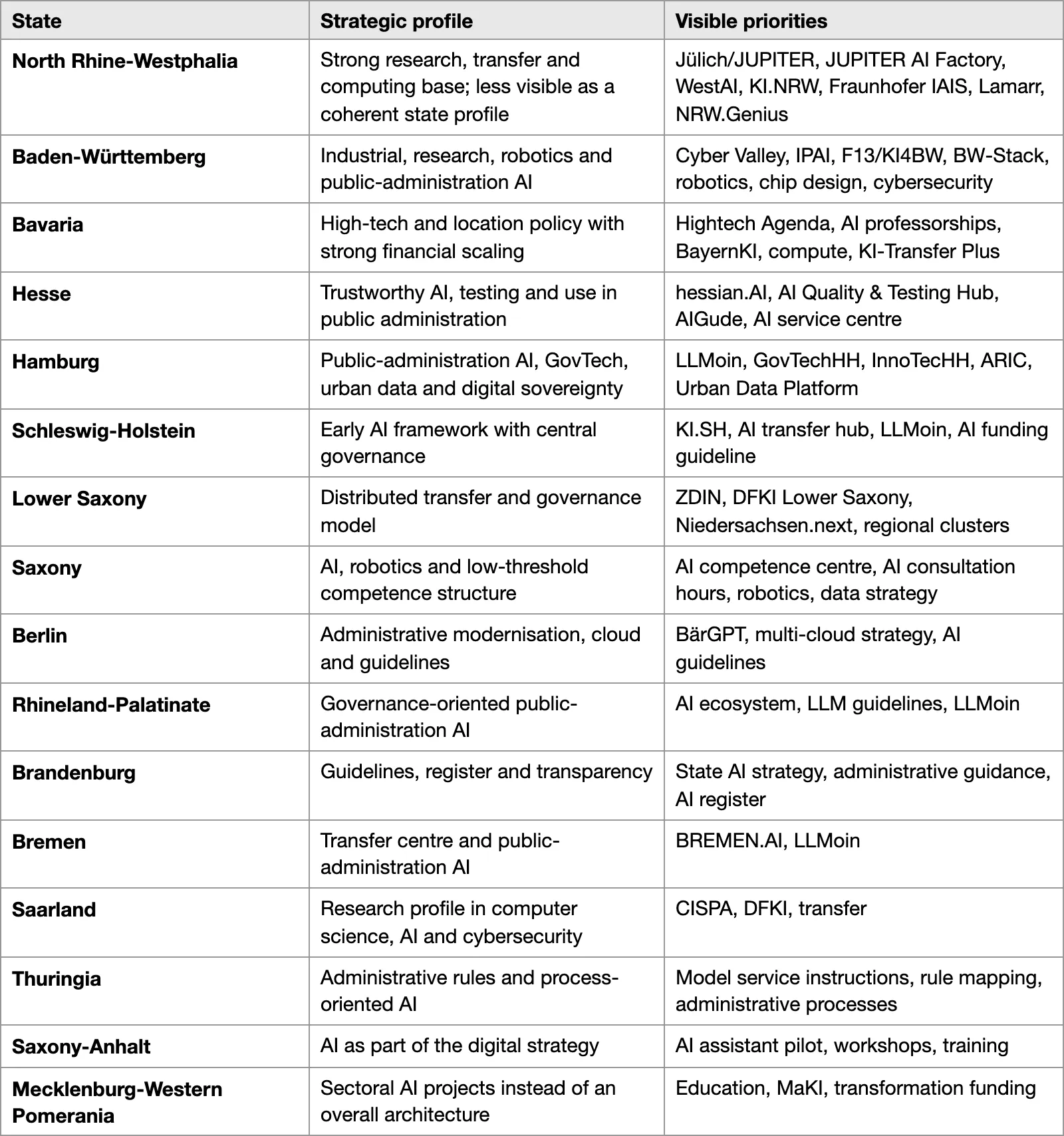
Nevertheless, several patterns can be identified: research- and HPC-driven models, administration-centred approaches with governance and their own assistance systems, transfer-oriented models for SMEs and regional ecosystems, and states whose AI policy is organised more by sector or by project.
Overview of the federal states
Fig. 1: Different AI profiles of the federal states. Own classification based on official state strategies, government documents and project sources; as of May 2026.
Sources for the overview of the states (in German): North Rhine-Westphalia: KI.NRW (öffnet in neuem Tab), coalition agreement 2022–2027 (öffnet in neuem Tab); Baden-Württemberg: F13 (öffnet in neuem Tab), coalition agreement 2026 (öffnet in neuem Tab); Bavaria: Hightech Agenda Bayern (öffnet in neuem Tab), BayernKI (öffnet in neuem Tab); Hesse: AI future agenda (öffnet in neuem Tab), AI Quality & Testing Hub (öffnet in neuem Tab); Hamburg: LLMoin (öffnet in neuem Tab), ARIC (öffnet in neuem Tab); Schleswig-Holstein: AI strategy 2.0 (öffnet in neuem Tab), KI.SH (öffnet in neuem Tab); Lower Saxony: AI strategy Lower Saxony (öffnet in neuem Tab), digitalisation roadmap (öffnet in neuem Tab); Saxony: AI strategy Saxony (öffnet in neuem Tab), AI competence centre (öffnet in neuem Tab); Berlin: government policy guidelines (öffnet in neuem Tab), BärGPT (öffnet in neuem Tab); Rhineland-Palatinate: digital strategy (öffnet in neuem Tab), AI ecosystem (öffnet in neuem Tab); Brandenburg: state AI strategy (öffnet in neuem Tab); Bremen: AI strategy Bremen (öffnet in neuem Tab), BREMEN.AI (öffnet in neuem Tab); Saarland: strategy for research and innovation 2024–2030 (öffnet in neuem Tab); Thuringia: AI strategy for the Thuringian state administration (öffnet in neuem Tab); Saxony-Anhalt: Sachsen-Anhalt Digital 2030 (öffnet in neuem Tab); Mecklenburg-Western Pomerania: AI transformation funding (öffnet in neuem Tab).
The overview is therefore not a ranking. It shows different state capabilities. This is precisely where an advantage of federalism can lie: Hesse does not have to become a copy of Bavaria, nor Schleswig-Holstein a second Baden-Württemberg. Different states can solve different problems.
This diversity only becomes problematic when successful solutions can hardly be transferred, technical systems remain incompatible or publicly funded developments are produced several times in parallel. The decisive yardstick for federal policy is therefore not standardisation, but scalability.
From innovation to scaling: where Germany’s AI policy must start
The example of North Rhine-Westphalia makes this particularly clear. NRW has KI.NRW, Fraunhofer IAIS, Lamarr, Jülich/JUPITER, WestAI, universities and a broad structure of industry and small and medium-sized enterprises. In research, computing power, transfer and industrial application, the state is therefore by no means a “blank slate”.
Other states, in turn, have built up other competences. Hesse combines research and compute with testing and trustworthy AI. Baden-Württemberg links research, industry, robotics, AI in public administration and computing infrastructure more closely at the institutional level. Schleswig-Holstein and Hamburg show how an AI assistant for public administration can be combined with roll-out and reuse across the federation. With its competence centre, Saxony offers a low-threshold model for orientation and questions about the AI Act.
The consequence for federal policy should not be to build similar institutions everywhere. The question is rather: how does a building block that works regionally become a capability that can be used across Germany or Europe? This is particularly evident in four areas: computing power, AI in public administration, regulatory implementation and industrial transfer.
Compute: access exists – now use must scale
Germany and Europe are now considerably expanding their AI computing infrastructure. The AI Continent Action Plan envisages AI Factories and Gigafactories as central elements of a European AI infrastructure. In spring 2026, 19 AI Factories (öffnet in neuem Tab) and 13 regional antennas across Europe were already part of this network.
Access is also broader than is often assumed. Science, public users and industry can use EuroHPC systems regardless of their location in Europe via the relevant access procedures; there are dedicated free access routes for start-ups and SMEs (öffnet in neuem Tab). Jülich plays an important role for Germany here: as a central point of contact, the JUPITER AI Factory (öffnet in neuem Tab) is to give start-ups, SMEs, industry, research and public actors in particular simplified access to the exascale system JUPITER.
The political demand should therefore no longer be to make computing power accessible nationwide in the first place. The next step is more difficult: existing access must become so simple, visible and application-oriented that companies can actually use it. EuroHPC (öffnet in neuem Tab) also recognises that coordination is still needed here: in April 2026, EuroHPC launched a call for a project intended, among other things, to create common service standards and a more harmonised user experience between AI Factories and their antennas.
This gives the federal government a concrete task: from a company’s point of view, German access to AI Factories, AI service centres and other compute offerings should appear as a coherent system as far as possible – regardless of which ministry, federal state or European programme finances the infrastructure in question. The yardstick is then no longer the infrastructure alone, but how quickly productive use emerges from existing infrastructure.
AI in public administration: reuse should become the norm
The question of federal scaling becomes particularly visible in AI for public administration. Several states are developing or using their own systems: F13 in Baden-Württemberg, LLMoin in Hamburg and Schleswig-Holstein among others, BärGPT in Berlin, AIGude in Hesse or NRW.Genius in North Rhine-Westphalia. Reuse and common interfaces are increasingly becoming part of these approaches.
This logic has now also become more concrete at federal level. The Deutschland-Stack explicitly follows the principle that components, once well developed, should be reused as widely as possible; open source, open standards and interoperability are linked to reusability. In March 2026, the federal government and the states agreed in the IT Planning Council (öffnet in neuem Tab) on a common platform core and binding standards for the Deutschland-Stack. Notably, the decision also explicitly highlights better interoperability in the use of AI. The federal government has also published its first AI modules as open source: the administrative building blocks developed in the SPARK (öffnet in neuem Tab) project are explicitly available for reuse.
Nevertheless, a blanket demand that every publicly funded AI development must be open source would go too far. Procurement, security, licensing and specialist requirements differ. A graduated principle would be more plausible:
For publicly funded AI projects in public administration, interoperability and reusability should in principle be examined and taken into account in funding decisions. Where open source makes technical and legal sense, it should be preferred; deviations should be justifiable.
This would not be a radical realignment, but a more consistent application of a development towards which the federal government and the states are already moving with the Deutschland-Stack.
AI Act: a law must become an infrastructure
The situation regarding the AI Act (öffnet in neuem Tab) has also developed further. Germany has now adopted its national implementing act; the new framework has been in force since the end of July 2026. The Federal Network Agency is taking on a central role in coordination and market surveillance and is receiving its own coordination and competence centre. It will also operate at least one AI regulatory sandbox.
The demand for a central point of contact therefore falls short today. The more interesting question is how this central responsibility can become a functioning support network for companies and public administrations. The Bundestag has itself taken up this challenge. The accompanying resolution on the implementing act calls for efficient and uniform market surveillance; the idea of a “one-stop shop” (öffnet in neuem Tab) should be pursued further. A common digital platform with interfaces between the supervisory authorities involved is also considered necessary.
This is relevant because regional competences already exist. Hesse has testing and quality structures. Saxony operates a low-threshold AI competence centre. Brandenburg has developed transparency and register approaches. Various states are working on guidelines and internal governance models for public administration. This expertise should not be displaced by a new federal structure, but connected. For a company, it must be as clear as possible where it can turn with a specific question, which testing and advisory services exist and whether a regional body, a federal service or a European service is responsible.
Regulation thus becomes infrastructure in its own right – not because more rules are needed, but because legal certainty is of only limited practical use to companies without accessible advice, testing and clear responsibilities.
Industrial AI: a German strength can lie in application
Another finding of the comparison of the states is the importance of industrial AI. Baden-Württemberg combines AI with robotics, chip design, cybersecurity and industrial value creation. Bavaria focuses on research, compute and transfer. Saxony combines AI with robotics and industrial transformation. North Rhine-Westphalia has a broad industrial base as well as strong research and computing structures.
This orientation fits the federal government’s Hightech Agenda (öffnet in neuem Tab). There, AI and microelectronics are among the six prioritised key technologies; the stated aim is to translate research into application and value creation more quickly. The European strategy also explicitly focuses on faster adoption of AI in strategic areas such as the health economy, the automotive industry and advanced manufacturing.
Here too, the yardstick is shifting. Germany’s competitiveness will not be decided solely by whether the world’s most powerful general language model comes from Germany. It will also be decided by whether a mechanical engineering firm, a logistics company, a chemical company or a medium-sized supplier can integrate AI productively into its processes. Several conditions must be in place at the same time for this: computing power, suitable data, AI skills, cybersecurity and transfer support.
The federal government already has the relevant instruments. Mittelstand-Digital (öffnet in neuem Tab), for example, supports SMEs with digitalisation, AI readiness and IT security. An evaluation of the programme showed more than 260,000 company contacts between 2021 and 2023, but also identified persistent obstacles such as a lack of skills, financial and time resources and legal uncertainty.
This argues against a purely quantitative funding logic. An advisory service is not yet an AI system in use, a demonstrator is not yet a scaled production process and a pilot project is not yet an increase in productivity. The next generation of industrial AI policy should therefore look more closely at the entire chain from access to technology to actual application.
What the federal government should do now
Five priorities can be derived from the comparison. Some of them are not entirely new political projects – and that is precisely what matters: the task increasingly consists of connecting structures that have already been started more consistently.
First: simplify access to compute instead of only building more capacity
Germany needs additional computing power. The Federal Government is therefore pursuing the goal of significantly expanding data centre capacity by 2030; the data centre strategy (öffnet in neuem Tab) explicitly justifies this with competitiveness and technological sovereignty. In parallel, large public capacities are already being created with JUPITER, AI Factories and European access models (öffnet in neuem Tab).
The federal government should therefore also focus on access: a clear overview of relevant resources, simple referral to the right service, coordinated access conditions and stronger support for SMEs on the way from the first experiment to productive use. Success would then not be measured solely by installed computing capacity, but by how widely this capacity is used productively.
Second: make interoperability and reuse the rule for publicly funded AI in public administration
The Deutschland-Stack already lays the foundation for this. For new AI projects in public administration, the federal government should therefore systematically have its own funding and projects examined to see whether existing solutions can be reused, which interfaces are required and whether the results can in turn be made usable for other administrations. Open source should be preferred where security, licensing and operational requirements permit.
This would not mean that every administration has to use the same application. But publicly funded innovation would be understood more as a common technological stock.
Third: organise the implementation of the AI Act as a federal support network
With the implementing act, the Federal Network Agency and the planned regulatory sandbox, the institutional core now exists. The next step should be to connect the Federal Network Agency, the states’ competences, regional testing and advisory bodies and European services in such a way that companies do not get lost between responsibilities.
The yardstick should be a one-stop approach that works in practice: a company asks a question and is directed to the right body – regardless of whether the relevant expertise sits with the federal government, in a federal state or at European level.
Fourth: promote industrial AI as a coherent technology chain
Compute, data, models, cybersecurity, microelectronics and transfer should be considered less in isolation; the Hightech Agenda and the European AI strategy are already moving in this direction. For specific funded projects, it should therefore be examined more closely whether an application has access to computing power and data, how cybersecurity is taken into account, how it can be scaled after the pilot stage and how it connects to existing transfer structures. Not every one of these points has to be part of a single funding programme. But within the overall architecture, they should fit together.
Fifth: measure impact more systematically – and scale successful structures
Germany does not necessarily need fewer AI programmes. But it does need a better understanding of which programmes actually have an impact. The evaluation of Mittelstand-Digital shows that such assessments are possible and politically useful: in addition to reach and company contacts, specific obstacles were identified and recommendations for the further development of the funding priority were derived.
This logic could be applied more widely to AI funding as a whole. In addition to classic indicators such as funding volume or number of participants, relevant questions would include, for example: how many pilot projects go into regular operation? How many companies continue to use a service after twelve or 24 months? How often are publicly funded solutions reused by other actors? And which projects mobilise additional private investment?
This would not make funding policy more defensive. On the contrary, it could become more ambitious – because funds could be shifted more quickly from projects without recognisable scaling to those structures that demonstrably work.
Conclusion: Germany’s strength must come from networking
The comparison of the federal states does not reveal a single best-practice model for AI policy. That need not be a disadvantage. Bavaria can scale research and compute. Baden-Württemberg can combine industrial AI, robotics and administrative infrastructure. Hesse has particular expertise in trustworthy AI and testing. Hamburg and Schleswig-Holstein are testing administrative applications that are relevant across the federation. Saxony combines industrial priorities with low-threshold advice. North Rhine-Westphalia brings research, computing and transfer structures.
The federal government’s task is not to turn this into sixteen identical AI landscapes. It is to ensure that regional strength can have an impact beyond the region: that compute from Jülich is not only geographically available, but actually accessible to companies; that a working administrative module does not have to be redeveloped in every state; that testing expertise from Hesse or regulatory advice from Saxony can become part of a larger German ecosystem. In short: that projects become infrastructure.
To achieve this, Germany also needs a more precise idea of technological sovereignty. Complete autarky would be neither realistic nor economically sensible. The EU itself combines economic security with openness and international partnerships – but on condition that critical dependencies are known and risks are limited. The guiding question should therefore not be whether every technology must come from Germany or Europe, but:
Which capabilities must we master ourselves, which dependencies can we justify – and which systems must be so open and interoperable that we can connect alternatives or switch in an emergency?
For security-relevant technologies, critical infrastructure and central supply chains, the answer must be stricter than for ordinary commercial applications. The European economic security strategy already takes account of this difference by examining AI, advanced semiconductors and other technologies close to dual-use separately for technological and security risks.
The strategic alternative to dependency is therefore not isolation, but capacity to act: through its own core competences, through controllable and resilient infrastructure, through open interfaces where cooperation makes sense, through a European division of labour where it creates strength, and through targeted protection where a loss of technological control would create economic or security vulnerability.
Germany will not simply copy American or Chinese AI development. But it does not have to derive a defensive strategy from this either. Its industrial base, its research institutions, the European single market and even its federalism can contribute to a different model: not sixteen or twenty-seven separate AI ecosystems, but an interoperable network of specialised capabilities.
Whether this actually gives rise to a European strength will depend less on how many new AI programmes are announced. What will be decisive is how well the existing capabilities work together.